|
Category: Uncategorised
-
newsletter (Dec 2023 – Issue 23)
-

newsletter (Dec 2023 – Issue 23)

关于香港桂冠论坛
欢迎大家来到香港桂冠论坛2023年12月份通讯。
由香港桂冠论坛委员会主办,李兆基基金全额赞助,以「汇聚顶尖思维 启发科学成就」(Meeting of Inspirational Minds)为主题的首届香港桂冠论坛(下称 「论坛」),已于11月13至18日假香港科学园圆满举行。为期一周的论坛盛况空前,一共涵盖三场精彩的专题演讲、六场互相交流精辟见解的分科小组讨论、两场深度剖析全球趋势话题的交流讨论、两场专题科学研讨会,还有超过20场多元化的参观和文化活动,其中包括四场在港岛、九龙、新界东、新界西区同步进行的邵逸夫奖得奖者与中学生对话,为香港开创先河的活动!部份论坛活动更设有网上直播,欢迎大家按此重温相关内容。此外,论坛委员会于论坛举行期间,特意为出席论坛的非本地媒体举办了一个「香港桂冠论坛传媒导赏团」,让他们更了解论坛内容及香港的科研发展,把这场大型科学盛事推向全球!有关传媒导赏团,请参阅下一篇文章以了解更多。
论坛吸引超过2,400名参加者,成功汇聚来自世界各地在天文学、生命科学与医学、数学科学三大领域中具杰出贡献的23位邵逸夫奖得奖者、全球来自近30个不同国家及地区近200名青年科学家及论坛大使、超过200位来自不同界别及机构的嘉宾和本地科学家,及超过1500位热衷科学的中学生和公众人士等。这次盛会让彼此互相交流连结,从而建立跨世代、跨文化、跨领域的联系,启发科学无限可能!论坛的精华相片及影片已上载至我们的图片库、影片库及YouTube频道,大家切勿错过!
论坛活动涵盖广泛且多元的主题,参加者得以深入探讨由天文学的重力波、黑洞、天文望远镜,数学科学的模空间、几何学、分形,以至生命科学与医学的基因、细胞、光遗传学等各个领域的课题。论坛还设有由超过40位青年科学家主持的海报简报和研究简报环节,让他们亲自向邵逸夫奖得奖者讲解其研究项目,并获授予宝贵意见,令青年科学家们获益良多。
从论坛举办期间以至结束,不少参加者对论坛给予正面评价,认为论坛是一个连接当代科学家与青年科学家的桥梁,对整体安排予以赞赏,并期望有机会参与下一届桂冠论坛,实在令我们感到非常鼓舞。有邵逸夫奖得奖者表示,在国际会议上遇上的一般只会是自己科研领域的人士,但真正让几个科学领域的人聚首一堂,是非常罕见且难得的。另外,有邵逸夫奖得奖者认为,论坛汇聚多届得奖者与青年科学家、学生们,其中一个概念是把前沿的科学和技术带给大家,让大家能了解当中的思维和应用,以改善人类的生活和体验,是一个非常关键且重要的举措。而青年科学家均表示透过参与论坛,从来自世界各地、从事不同领域的邵逸夫奖得奖者身上获得启发,认为他们分享于科研路上的心得和建议,甚具参考价值,更有不只一位青年科学家表示,对于追求热衷之事将不会止步,并继续其科研之路。
论坛得以成功举办,实有赖社会各界一直以来鼎力支持,论坛委员会在此衷心鸣谢以下单位:
主要赞助机构
李兆基基金主要合作伙伴
邵逸夫奖指定旅游赞助
国泰航空其他赞助
投资推广署 香港铁路有限公司 南旋集团 西九文化区 小米集团 本地学术伙伴
香港城市大学 香港浸会大学 香港都会大学 岭南大学 香港中文大学 香港教育大学 香港理工大学 香港科技大学 香港大学 合作机构
法国驻港澳总领事馆 裘槎基金会 数码港 啬色园主办可观自然教育中心暨天文馆 香港应用科技研究院 香港中学校长会 香港天文学会 香港天文台 香港科技园 香港科学馆 香港工业与应用数学学会 香港太空馆 政府新闻处 物流及供应链多元技术研发中心 纳米及先进材料研发院 儒莲教科文机构 香港恒生大学 香港资优教育学苑 香港科学院 香港电脑教育学会 香港青年协会 香港纺织及成衣研发中心 妇女基金会 大学教育资助委员会 论坛结束后,论坛委员会继续「探索新视野2024」的筹备工作。桂冠论坛已连续第三年举办「探索新视野」,并会于来年1月至3月联同香港本地科学家/研究团队,为香港高年级中学生安排参观其实验室以及进行对谈会。一如以往,活动旨在让学生透过亲身体验和提问,了解科学家们的工作环境、实验室的运作、科学家们研究过程中遇到的困难,及香港最新的科研项目等,借此提升中学生对科研的兴趣。
最后,桂冠论坛预祝大家新年进步,身体健康!
香港桂冠论坛传媒导赏团
香港桂冠论坛委员会于11月13至17日举办了传媒导赏团,安排应邀的非本地传媒机构代表出席首届香港桂冠论坛的活动,包括专题演讲、青年科学家海报简报、分科小组讨论、全球趋势话题讨论、邵逸夫奖得奖者与中学生对话等活动,让传媒友好了解论坛内容,亲身体验科研交流的氛围。除了出席论坛活动,他们亦参观了香港顶尖科研设施,例如InnoHK创新研发中心,与科研团队对话,深入了解香港最新科研项目。此外,他们还参观了香港著名地标,加深他们对香港的认识。
超过20位受邀传媒分别来自中国来地,包括北京、上海、深圳等,亦有来自印度、肯亚、波兰、南韩、泰国、英国、土耳其。不少媒体机构代表对于出席论坛活动及与邵逸夫奖得奖者深度对谈表示高兴,让他们深入了解现今科研发展。部份媒体机构代表更表示,举办邵逸夫奖得奖者与中学生对话富有意义,认为论坛创造机会,使中学生能与获奖科学家对话,了解他们的研究项目、当中遇到的挑战等,有助他们规划投身科研。
桂冠论坛感谢各个单位的支持及款待,令传媒导赏团得以顺利举行,同时感谢科研团队及机构代表详细介绍各个研究项目及设施,当中包括:
- 中药创新研发中心 – 林成源博士及其研究团队
- 眼视觉研究中心 – 彭志刚博士及其研究团队
- 创新诊断科技中心 – 江培勇博士及其研究团队
- 干细胞转化研究中心 – 刘澎涛教授及其研究团队
- 数码港
- 香港科技园公司创科体验馆
- 香港心脑血管健康工程研究中心 – 陈苇恩教授及其研究团队
- 香港智慧建造研发中心 – 梁浩博博士及其研究团队
- 香港故宫文化博物馆
- The Henderson
论坛委员会期望是次导赏团能让传媒友好把论坛的资讯带到世界各地,让各个地方的民众能认识这个跨世代、跨文化、跨领域的国际性科学交流盛会。
星体连珠:银河系中心令人惊讶的发现
有些时候,科学家如果幸运的话,会在研究里遇上一些奇异的事情,使得他必须退后一步,思考到底出现了什么问题?本文正是要从事实的角度,来探讨这个奇异的故事 — 有时候,真正的科学就是这样产生的。
有时,我们会以新闻稿形式,发布我们圑队认为值得介绍的科学发现。以此吸引各界的采访、引用,有时甚至会被疯传,此为我们的研究工作了正面宣传。正如,2023年7月的一篇新闻稿被广传后,有人因此在科学杂志上发表了一篇大受欢迎的文章,也有一位在科学界里很有份量的人士制作了一段长达 10 分钟的 Youtube 视频,介绍我们的研究,其观看次数高达 10 万次;美国天文学会 (AAS) 亦就该项研究制作了一段更为专业的 Youtube 采访,其观看次数更高于几乎所有其他经美国天文学会的同行评审的主要学术文章的同类视频。凡此种种,都显示了这个「奇怪的科学结果」的重要性。对此,下文将作更清楚的讲述。

作者:
香港大学太空实验室总监及物理系教授 柏坤霆教授
香港大学太空实验室研究助理 谭舒宇小姐
指纹:判别个人身分的特征
简介
在使用血液测试和DNA分析这些复杂方法之前,我们早已有一套简单直接的方法来辨别身分,那就是我们经常在电影中看到或是通关会用到的指纹分析。指纹又称为「皮嵴」(friction ridge skin),像我们的容貌一样,它是我们独一无二的特征。可是你有想过为甚么每个人的指纹都不同吗?答案在于基因(尤其是控制四肢发育的基因)和环境间的相互作用,它们创造出能被分成三个类别的独特皮纹图样(dermatoglyphic patterns):弧纹(arch)、箕纹(loop)和斗纹(whorl)。
图一:指纹的三个类别:弧纹、箕纹和斗纹
指纹的形成
科学界对指纹形成有著不同理论,但皮肤学家倾向相信折叠假说 [1]。皮肤组织由紧密连接的三层垂直结构组成,分别是表皮、基底层和真皮。顶层的表皮和底层的真皮细胞生长速度的差别在快速生长的基底层构成张力,使其在不同位置折叠以释放张力。细胞继续在折叠的地方增生的同时,不同拱起的折叠会颇为随机地集结成群,形成一条条皮嵴,产生指纹中独特的皱褶图案。
作者:苏柏安 香港科技大学《科言》学生编辑
设计︰林晓薏 香港科技大学《科言》学生设计师
翻译:刘劭行 香港科技大学《科言》总编辑
Wordle大揭秘:资讯理论101
上年网上游戏Wordle的风潮席卷全球,大家的社交媒体好一阵子都被绿色、黄色和灰色的方格占据。你可能见过朋友夸耀自己只猜了三次就已解开当天谜题,也有时会沮丧地抱怨当天只能以「X/6」饮恨作结,未能揭开当天谜底。当我们思考应用甚么单字开始游戏时,我们也许会很随性地把一个五个字母长的任意单字填进空格,但其实这其实是一个科学问题。我们不难意识到有些单字比别的好,对我们稍后的猜测更为有利,譬如选择「FUZZY」远比「RAISE」不智,因为前者包括的字母远比后者冷门。那么,哪个单字才是能帮我们赢出游戏的最佳选择呢?
什么是Wordle?
我们假设读者知道Wordle的运作方式,但如果你不知道的话,以下是懒人包。
Wordle的数据库包含2,315个由开发者挑选,五个字母长作为答案的单字,也有大概13,000个被系统视为存在的有效单字(里面除了2,315个作为答案的单字外,还包括许多不常用的单字)。每天程式都会从数据库抽取一个单字作为当天游戏的答案。如果你猜的单字包含答案里有的字母,而该字母位于正确的位置上,该方格将会变为绿色;如字母正确,但位置错误,该方格将变为黄色;如答案并没有包含该字母,方格则会变为灰色。
作者︰蔡蒨珩 香港科技大学《科言》学生编辑
设计︰付一乙 香港科技大学《科言》学生设计师


If you want to unsubscribe our newsletter,
please
reply this e-mail directly.如欲取消訂閱本論壇電子通訊,請直接回覆此電郵。

-
newsletter (Dec 2023 – Issue 23)
關於香港桂冠論壇
歡迎大家來到香港桂冠論壇2023年12月份通訊。
由香港桂冠論壇委員會主辦,李兆基基金全額贊助,以「匯聚頂尖思維 啟發科學成就」(Meeting of Inspirational Minds)為主題的首屆香港桂冠論壇(下稱 「論壇」),已於11月13至18日假香港科學園圓滿舉行。為期一周的論壇盛況空前,一共涵蓋三場精彩的專題演講、六場互相交流精闢見解的分科小組討論、兩場深度剖析全球趨勢話題的交流討論、兩場專題科學研討會,還有超過20場多元化的參觀和文化活動,其中包括四場在港島、九龍、新界東、新界西區同步進行的邵逸夫獎得獎者與中學生對話,為香港開創先河的活動!部份論壇活動更設有網上直播,歡迎大家按此重溫相關內容。此外,論壇委員會於論壇舉行期間,特意為出席論壇的非本地媒體舉辦了一個「香港桂冠論壇傳媒導賞團」,讓他們更了解論壇內容及香港的科研發展,把這場大型科學盛事推向全球!有關傳媒導賞團,請參閱下一篇文章以了解更多。
論壇吸引超過2,400名參加者,成功匯聚來自世界各地在天文學、生命科學與醫學、數學科學三大領域中具傑出貢獻的23位邵逸夫獎得獎者、全球來自近30個不同國家及地區近200名青年科學家及論壇大使、超過200位來自不同界別及機構的嘉賓和本地科學家,及超過1500位熱衷科學的中學生和公眾人士等。這次盛會讓彼此互相交流連結,從而建立跨世代、跨文化、跨領域的聯繫,啟發科學無限可能!論壇的精華相片及影片已上載至我們的圖片庫、影片庫及YouTube頻道,大家切勿錯過!
論壇活動涵蓋廣泛且多元的主題,參加者得以深入探討由天文學的重力波、黑洞、天文望遠鏡,數學科學的模空間、幾何學、分形,以至生命科學與醫學的基因、細胞、光遺傳學等各個領域的課題。論壇還設有由超過40位青年科學家主持的海報簡報和研究簡報環節,讓他們親自向邵逸夫獎得獎者講解其研究項目,並獲授予寶貴意見,令青年科學家們獲益良多。
從論壇舉辦期間以至結束,不少參加者對論壇給予正面評價,認為論壇是一個連接當代科學家與青年科學家的橋樑,對整體安排予以讚賞,並期望有機會參與下一屆桂冠論壇,實在令我們感到非常鼓舞。有邵逸夫獎得獎者表示,在國際會議上遇上的一般只會是自己科研領域的人士,但真正讓幾個科學領域的人聚首一堂,是非常罕見且難得的。另外,有邵逸夫獎得獎者認為,論壇匯聚多屆得獎者與青年科學家、學生們,其中一個概念是把前沿的科學和技術帶給大家,讓大家能了解當中的思維和應用,以改善人類的生活和體驗,是一個非常關鍵且重要的舉措。而青年科學家均表示透過參與論壇,從來自世界各地、從事不同領域的邵逸夫獎得獎者身上獲得啟發,認為他們分享於科研路上的心得和建議,甚具參考價值,更有不只一位青年科學家表示,對於追求熱衷之事將不會止步,並繼續其科研之路。
論壇得以成功舉辦,實有賴社會各界一直以來鼎力支持,論壇委員會在此衷心鳴謝以下單位:
主要贊助機構
李兆基基金主要合作伙伴
邵逸夫獎指定旅遊贊助
國泰航空其他贊助
投資推廣署 香港鐵路有限公司 南旋集團 西九文化區 小米集團 本地學術伙伴
香港城市大學 香港浸會大學 香港都會大學 嶺南大學 香港中文大學 香港教育大學 香港理工大學 香港科技大學 香港大學 合作機構
法國駐港澳總領事館 裘槎基金會 數碼港 嗇色園主辦可觀自然教育中心暨天文館 香港應用科技研究院 香港中學校長會 香港天文學會 香港天文台 香港科技園 香港科學館 香港工業與應用數學學會 香港太空館 政府新聞處 物流及供應鏈多元技術研發中心 納米及先進材料研發院 儒蓮教科文機構 香港恒生大學 香港資優教育學苑 香港科學院 香港電腦教育學會 香港青年協會 香港紡織及成衣研發中心 婦女基金會 大學教育資助委員會 論壇結束後,論壇委員會繼續「探索新視野2024」的籌備工作。桂冠論壇已連續第三年舉辦「探索新視野」,並會於來年1月至3月聯同香港本地科學家/研究團隊,為香港高年級中學生安排參觀其實驗室以及進行對談會。一如以往,活動旨在讓學生透過親身體驗和提問,了解科學家們的工作環境、實驗室的運作、科學家們研究過程中遇到的困難,及香港最新的科研項目等,藉此提升中學生對科研的興趣。
最後,桂冠論壇預祝大家新年進步,身體健康!
香港桂冠論壇傳媒導賞團
香港桂冠論壇委員會於11月13至17日舉辦了傳媒導賞團,安排應邀的非本地傳媒機構代表出席首屆香港桂冠論壇的活動,包括專題演講、青年科學家海報簡報、分科小組討論、全球趨勢話題討論、邵逸夫獎得獎者與中學生對話等活動,讓傳媒友好了解論壇內容,親身體驗科研交流的氛圍。除了出席論壇活動,他們亦參觀了香港頂尖科研設施,例如InnoHK創新研發中心,與科研團隊對話,深入了解香港最新科研項目。此外,他們還參觀了香港著名地標,加深他們對香港的認識。
超過20位受邀傳媒分別來自中國來地,包括北京、上海、深圳等,亦有來自印度、肯亞、波蘭、南韓、泰國、英國、土耳其。不少媒體機構代表對於出席論壇活動及與邵逸夫獎得獎者深度對談表示高興,讓他們深入了解現今科研發展。部份媒體機構代表更表示,舉辦邵逸夫獎得獎者與中學生對話富有意義,認為論壇創造機會,使中學生能與獲獎科學家對話,了解他們的研究項目、當中遇到的挑戰等,有助他們規劃投身科研。
桂冠論壇感謝各個單位的支持及款待,令傳媒導賞團得以順利舉行,同時感謝科研團隊及機構代表詳細介紹各個研究項目及設施,當中包括:
- 中藥創新研發中心 – 林成源博士及其研究團隊
- 眼視覺研究中心 – 彭志剛博士及其研究團隊
- 創新診斷科技中心 – 江培勇博士及其研究團隊
- 幹細胞轉化研究中心 – 劉澎濤教授及其研究團隊
- 數碼港
- 香港科技園公司創科體驗館
- 香港心腦血管健康工程研究中心 – 陳葦恩教授及其研究團隊
- 香港智慧建造研發中心 – 梁浩博博士及其研究團隊
- 香港故宮文化博物館
- The Henderson
論壇委員會期望是次導賞團能讓傳媒友好把論壇的資訊帶到世界各地,讓各個地方的民眾能認識這個跨世代、跨文化、跨領域的國際性科學交流盛會。
星體連珠:銀河系中心令人驚訝的發現
有些時候,科學家如果幸運的話,會在研究裏遇上一些奇異的事情,使得他必須退後一步,思考到底出現了什麼問題?本文正是要從事實的角度,來探討這個奇異的故事 — 有時候,真正的科學就是這樣產生的。
有時,我們會以新聞稿形式,發佈我們圑隊認為值得介紹的科學發現。以此吸引各界的採訪、引用,有時甚至會被瘋傳,此為我們的研究工作了正面宣傳。正如,2023年7月的一篇新聞稿被廣傳後,有人因此在科學雜誌上發表了一篇大受歡迎的文章,也有一位在科學界裏很有份量的人士製作了一段長達 10 分鐘的 Youtube 視頻,介紹我們的研究,其觀看次數高達 10 萬次;美國天文學會 (AAS) 亦就該項研究製作了一段更為專業的 Youtube 採訪,其觀看次數更高於幾乎所有其他經美國天文學會的同行評審的主要學術文章的同類視頻。凡此種種,都顯示了這個「奇怪的科學結果」的重要性。對此,下文將作更清楚的講述。
作者:
香港大學太空實驗室總監及物理系教授 柏坤霆教授
香港大學太空實驗室研究助理 譚舒宇小姐
指紋:判別個人身分的特徵
簡介
在使用血液測試和DNA分析這些複雜方法之前,我們早已有一套簡單直接的方法來辨別身分,那就是我們經常在電影中看到或是通關會用到的指紋分析。指紋又稱為「皮嵴」(friction ridge skin),像我們的容貌一樣,它是我們獨一無二的特徵。可是你有想過為甚麼每個人的指紋都不同嗎?答案在於基因(尤其是控制四肢發育的基因)和環境間的相互作用,它們創造出能被分成三個類別的獨特皮紋圖樣(dermatoglyphic patterns):弧紋(arch)、箕紋(loop)和斗紋(whorl)。
圖一:指紋的三個類別:弧紋、箕紋和斗紋
指紋的形成
科學界對指紋形成有著不同理論,但皮膚學家傾向相信摺疊假說 [1]。皮膚組織由緊密連接的三層垂直結構組成,分別是表皮、基底層和真皮。頂層的表皮和底層的真皮細胞生長速度的差別在快速生長的基底層構成張力,使其在不同位置摺疊以釋放張力。細胞繼續在摺疊的地方增生的同時,不同拱起的摺疊會頗為隨機地集結成群,形成一條條皮嵴,產生指紋中獨特的皺褶圖案。
作者:蘇柏安 香港科技大學《科言》學生編輯
設計︰林曉薏 香港科技大學《科言》學生設計師
翻譯:劉劭行 香港科技大學《科言》總編輯
Wordle大揭秘:資訊理論101
上年網上遊戲Wordle的風潮席捲全球,大家的社交媒體好一陣子都被綠色、黃色和灰色的方格佔據。你可能見過朋友誇耀自己只猜了三次就已解開當天謎題,也有時會沮喪地抱怨當天只能以「X/6」飲恨作結,未能揭開當天謎底。當我們思考應用甚麼單字開始遊戲時,我們也許會很隨性地把一個五個字母長的任意單字填進空格,但其實這其實是一個科學問題。我們不難意識到有些單字比別的好,對我們稍後的猜測更為有利,譬如選擇「FUZZY」遠比「RAISE」不智,因為前者包括的字母遠比後者冷門。那麼,哪個單字才是能幫我們贏出遊戲的最佳選擇呢?
甚麼是Wordle?
我們假設讀者知道Wordle的運作方式,但如果你不知道的話,以下是懶人包。
Wordle的數據庫包含2,315個由開發者挑選,五個字母長作為答案的單字,也有大概13,000個被系統視為存在的有效單字(裡面除了2,315個作為答案的單字外,還包括許多不常用的單字)。每天程式都會從數據庫抽取一個單字作為當天遊戲的答案。如果你猜的單字包含答案裡有的字母,而該字母位於正確的位置上,該方格將會變為綠色;如字母正確,但位置錯誤,該方格將變為黃色;如答案並沒有包含該字母,方格則會變為灰色。
作者︰蔡蒨珩 香港科技大學《科言》學生編輯
設計︰付一乙 香港科技大學《科言》學生設計師
If you want to unsubscribe our newsletter,
please
reply this e-mail directly.如欲取消訂閱本論壇電子通訊,請直接回覆此電郵。
-
newsletter (Dec 2023 – Issue 23)
关于香港桂冠论坛
欢迎大家来到香港桂冠论坛2023年12月份通讯。
由香港桂冠论坛委员会主办,李兆基基金全额赞助,以「汇聚顶尖思维 启发科学成就」(Meeting of Inspirational Minds)为主题的首届香港桂冠论坛(下称 「论坛」),已于11月13至18日假香港科学园圆满举行。为期一周的论坛盛况空前,一共涵盖三场精彩的专题演讲、六场互相交流精辟见解的分科小组讨论、两场深度剖析全球趋势话题的交流讨论、两场专题科学研讨会,还有超过20场多元化的参观和文化活动,其中包括四场在港岛、九龙、新界东、新界西区同步进行的邵逸夫奖得奖者与中学生对话,为香港开创先河的活动!部份论坛活动更设有网上直播,欢迎大家按此重温相关内容。此外,论坛委员会于论坛举行期间,特意为出席论坛的非本地媒体举办了一个「香港桂冠论坛传媒导赏团」,让他们更了解论坛内容及香港的科研发展,把这场大型科学盛事推向全球!有关传媒导赏团,请参阅下一篇文章以了解更多。
论坛吸引超过2,400名参加者,成功汇聚来自世界各地在天文学、生命科学与医学、数学科学三大领域中具杰出贡献的23位邵逸夫奖得奖者、全球来自近30个不同国家及地区近200名青年科学家及论坛大使、超过200位来自不同界别及机构的嘉宾和本地科学家,及超过1500位热衷科学的中学生和公众人士等。这次盛会让彼此互相交流连结,从而建立跨世代、跨文化、跨领域的联系,启发科学无限可能!论坛的精华相片及影片已上载至我们的图片库、影片库及YouTube频道,大家切勿错过!
论坛活动涵盖广泛且多元的主题,参加者得以深入探讨由天文学的重力波、黑洞、天文望远镜,数学科学的模空间、几何学、分形,以至生命科学与医学的基因、细胞、光遗传学等各个领域的课题。论坛还设有由超过40位青年科学家主持的海报简报和研究简报环节,让他们亲自向邵逸夫奖得奖者讲解其研究项目,并获授予宝贵意见,令青年科学家们获益良多。
从论坛举办期间以至结束,不少参加者对论坛给予正面评价,认为论坛是一个连接当代科学家与青年科学家的桥梁,对整体安排予以赞赏,并期望有机会参与下一届桂冠论坛,实在令我们感到非常鼓舞。有邵逸夫奖得奖者表示,在国际会议上遇上的一般只会是自己科研领域的人士,但真正让几个科学领域的人聚首一堂,是非常罕见且难得的。另外,有邵逸夫奖得奖者认为,论坛汇聚多届得奖者与青年科学家、学生们,其中一个概念是把前沿的科学和技术带给大家,让大家能了解当中的思维和应用,以改善人类的生活和体验,是一个非常关键且重要的举措。而青年科学家均表示透过参与论坛,从来自世界各地、从事不同领域的邵逸夫奖得奖者身上获得启发,认为他们分享于科研路上的心得和建议,甚具参考价值,更有不只一位青年科学家表示,对于追求热衷之事将不会止步,并继续其科研之路。
论坛得以成功举办,实有赖社会各界一直以来鼎力支持,论坛委员会在此衷心鸣谢以下单位:
主要赞助机构
李兆基基金主要合作伙伴
邵逸夫奖指定旅游赞助
国泰航空其他赞助
投资推广署 香港铁路有限公司 南旋集团 西九文化区 小米集团 本地学术伙伴
香港城市大学 香港浸会大学 香港都会大学 岭南大学 香港中文大学 香港教育大学 香港理工大学 香港科技大学 香港大学 合作机构
法国驻港澳总领事馆 裘槎基金会 数码港 啬色园主办可观自然教育中心暨天文馆 香港应用科技研究院 香港中学校长会 香港天文学会 香港天文台 香港科技园 香港科学馆 香港工业与应用数学学会 香港太空馆 政府新闻处 物流及供应链多元技术研发中心 纳米及先进材料研发院 儒莲教科文机构 香港恒生大学 香港资优教育学苑 香港科学院 香港电脑教育学会 香港青年协会 香港纺织及成衣研发中心 妇女基金会 大学教育资助委员会 论坛结束后,论坛委员会继续「探索新视野2024」的筹备工作。桂冠论坛已连续第三年举办「探索新视野」,并会于来年1月至3月联同香港本地科学家/研究团队,为香港高年级中学生安排参观其实验室以及进行对谈会。一如以往,活动旨在让学生透过亲身体验和提问,了解科学家们的工作环境、实验室的运作、科学家们研究过程中遇到的困难,及香港最新的科研项目等,借此提升中学生对科研的兴趣。
最后,桂冠论坛预祝大家新年进步,身体健康!
香港桂冠论坛传媒导赏团
香港桂冠论坛委员会于11月13至17日举办了传媒导赏团,安排应邀的非本地传媒机构代表出席首届香港桂冠论坛的活动,包括专题演讲、青年科学家海报简报、分科小组讨论、全球趋势话题讨论、邵逸夫奖得奖者与中学生对话等活动,让传媒友好了解论坛内容,亲身体验科研交流的氛围。除了出席论坛活动,他们亦参观了香港顶尖科研设施,例如InnoHK创新研发中心,与科研团队对话,深入了解香港最新科研项目。此外,他们还参观了香港著名地标,加深他们对香港的认识。
超过20位受邀传媒分别来自中国来地,包括北京、上海、深圳等,亦有来自印度、肯亚、波兰、南韩、泰国、英国、土耳其。不少媒体机构代表对于出席论坛活动及与邵逸夫奖得奖者深度对谈表示高兴,让他们深入了解现今科研发展。部份媒体机构代表更表示,举办邵逸夫奖得奖者与中学生对话富有意义,认为论坛创造机会,使中学生能与获奖科学家对话,了解他们的研究项目、当中遇到的挑战等,有助他们规划投身科研。
桂冠论坛感谢各个单位的支持及款待,令传媒导赏团得以顺利举行,同时感谢科研团队及机构代表详细介绍各个研究项目及设施,当中包括:
- 中药创新研发中心 – 林成源博士及其研究团队
- 眼视觉研究中心 – 彭志刚博士及其研究团队
- 创新诊断科技中心 – 江培勇博士及其研究团队
- 干细胞转化研究中心 – 刘澎涛教授及其研究团队
- 数码港
- 香港科技园公司创科体验馆
- 香港心脑血管健康工程研究中心 – 陈苇恩教授及其研究团队
- 香港智慧建造研发中心 – 梁浩博博士及其研究团队
- 香港故宫文化博物馆
- The Henderson
论坛委员会期望是次导赏团能让传媒友好把论坛的资讯带到世界各地,让各个地方的民众能认识这个跨世代、跨文化、跨领域的国际性科学交流盛会。
星体连珠:银河系中心令人惊讶的发现
有些时候,科学家如果幸运的话,会在研究里遇上一些奇异的事情,使得他必须退后一步,思考到底出现了什么问题?本文正是要从事实的角度,来探讨这个奇异的故事 — 有时候,真正的科学就是这样产生的。
有时,我们会以新闻稿形式,发布我们圑队认为值得介绍的科学发现。以此吸引各界的采访、引用,有时甚至会被疯传,此为我们的研究工作了正面宣传。正如,2023年7月的一篇新闻稿被广传后,有人因此在科学杂志上发表了一篇大受欢迎的文章,也有一位在科学界里很有份量的人士制作了一段长达 10 分钟的 Youtube 视频,介绍我们的研究,其观看次数高达 10 万次;美国天文学会 (AAS) 亦就该项研究制作了一段更为专业的 Youtube 采访,其观看次数更高于几乎所有其他经美国天文学会的同行评审的主要学术文章的同类视频。凡此种种,都显示了这个「奇怪的科学结果」的重要性。对此,下文将作更清楚的讲述。
作者:
香港大学太空实验室总监及物理系教授 柏坤霆教授
香港大学太空实验室研究助理 谭舒宇小姐
指纹:判别个人身分的特征
简介
在使用血液测试和DNA分析这些复杂方法之前,我们早已有一套简单直接的方法来辨别身分,那就是我们经常在电影中看到或是通关会用到的指纹分析。指纹又称为「皮嵴」(friction ridge skin),像我们的容貌一样,它是我们独一无二的特征。可是你有想过为甚么每个人的指纹都不同吗?答案在于基因(尤其是控制四肢发育的基因)和环境间的相互作用,它们创造出能被分成三个类别的独特皮纹图样(dermatoglyphic patterns):弧纹(arch)、箕纹(loop)和斗纹(whorl)。
图一:指纹的三个类别:弧纹、箕纹和斗纹
指纹的形成
科学界对指纹形成有著不同理论,但皮肤学家倾向相信折叠假说 [1]。皮肤组织由紧密连接的三层垂直结构组成,分别是表皮、基底层和真皮。顶层的表皮和底层的真皮细胞生长速度的差别在快速生长的基底层构成张力,使其在不同位置折叠以释放张力。细胞继续在折叠的地方增生的同时,不同拱起的折叠会颇为随机地集结成群,形成一条条皮嵴,产生指纹中独特的皱褶图案。
作者:苏柏安 香港科技大学《科言》学生编辑
设计︰林晓薏 香港科技大学《科言》学生设计师
翻译:刘劭行 香港科技大学《科言》总编辑
Wordle大揭秘:资讯理论101
上年网上游戏Wordle的风潮席卷全球,大家的社交媒体好一阵子都被绿色、黄色和灰色的方格占据。你可能见过朋友夸耀自己只猜了三次就已解开当天谜题,也有时会沮丧地抱怨当天只能以「X/6」饮恨作结,未能揭开当天谜底。当我们思考应用甚么单字开始游戏时,我们也许会很随性地把一个五个字母长的任意单字填进空格,但其实这其实是一个科学问题。我们不难意识到有些单字比别的好,对我们稍后的猜测更为有利,譬如选择「FUZZY」远比「RAISE」不智,因为前者包括的字母远比后者冷门。那么,哪个单字才是能帮我们赢出游戏的最佳选择呢?
什么是Wordle?
我们假设读者知道Wordle的运作方式,但如果你不知道的话,以下是懒人包。
Wordle的数据库包含2,315个由开发者挑选,五个字母长作为答案的单字,也有大概13,000个被系统视为存在的有效单字(里面除了2,315个作为答案的单字外,还包括许多不常用的单字)。每天程式都会从数据库抽取一个单字作为当天游戏的答案。如果你猜的单字包含答案里有的字母,而该字母位于正确的位置上,该方格将会变为绿色;如字母正确,但位置错误,该方格将变为黄色;如答案并没有包含该字母,方格则会变为灰色。
作者︰蔡蒨珩 香港科技大学《科言》学生编辑
设计︰付一乙 香港科技大学《科言》学生设计师
If you want to unsubscribe our newsletter,
please
reply this e-mail directly.如欲取消訂閱本論壇電子通訊,請直接回覆此電郵。
-
newsletter (Mar 2024 – Issue 24)

About the Hong Kong Laureate Forum
Welcome to the March 2024 issue of the newsletter of the Hong Kong Laureate Forum!
The “Scientists and Their Contributions Voxel Art Design Contest”, jointly organised by the Council of the Hong Kong Laureate Forum (“the HKLF”), Index Game and The Sandbox, was staged and the award presentation ceremony concluded successfully on 2 March. We were honoured to have Ms Becky Wong, Chief Operation Officer and Co-founder of Index Game, Mr Erich Wong, Head of Growth (Hong Kong) of The Sandbox, Dr Jimmy Wong, Executive Director of the Hong Kong Academy of Gifted Education (HKAGE), and Prof Timothy Tong, BBS, JP, Chairman of the HKLF, to commend the participating teams. The Champion, 1st Runner-up and 2nd Runner-up teams were from Cotton Spinners Association Secondary School, Hong Kong University Graduate Association College and Fukien Secondary School respectively. These teams shared with the audience their experience and insights gained in the contest, including how they collaborated with their team members, the challenges they encountered during the production process, and how to enhance the likeness of their work. Members of the Champion team also talked about their experience in the two-day internship at Index Game, offering a glimpse of the daily work of a voxel art designer. The contest attracted 21 teams of students from 11 secondary schools. It was impressive that the participating teams went from attending the design software workshops to creating their own work in just two months. The award presenters recognised and appreciated the efforts and dedication of all participating teams. The masterpieces of the Champion, 1st Runner-up and 2nd Runner-up teams are now available on our website for everyone to visit. In addition, photos and highlights of the award presentation ceremony have been uploaded onto our photo gallery, video gallery and YouTube channel. Make sure you don’t miss the remarkable moments of the ceremony!
Time flies. Our signature event, “Exploring New Horizons”, has entered its third year. From January to March this year, we successfully organised “Exploring New Horizons 2024” – a series of 13 laboratory / enterprise visits along with sharing sessions specifically designed for senior secondary students in Hong Kong. The event garnered participation from over 300 individuals across 20 schools. The participating students had opportunities to interact with local scientists / research teams and delve into their work environment, laboratory operation, challenges faced by the research teams, and the latest scientific research projects in Hong Kong. We are delighted that a number of local scientists / research teams have supported this event for the second, or even the third consecutive year. Moreover, we are proud to announce that “Exploring New Horizons 2024” received support from a state key laboratory for the first time. This significant endorsement created opportunities for students to gain exposure to national key research projects. Also, we embarked on a collaboration with a local start-up, introducing students to medical metal 3D printing technology and application. The event photos and captivating highlights have been uploaded to our photo gallery, video gallery and YouTube channel and please enjoy! The HKLF extends its heartfelt gratitude to the enthusiastic participation of all students and teachers and the support of the local scientists / research teams / start-ups. They include:
Prof Chan Chi Hou and his research team from State Key Laboratory of Terahertz and Millimeter Waves (City University of Hong Kong)
Prof Kannie Chan and her research team from Hong Kong Centre for Cerebro-Cardiovascular Health Engineering
Prof Tom Cheung and his research team from the Division of Life Science of The Hong Kong University of Science and Technology
Prof Chu Ming-chung and his research team from the Department of Physics of the Chinese University of Hong Kong
Dr Calvin Or and his research team from the Department of Industrial & Manufacturing Systems Engineering of the University of Hong Kong
Prof Patrick Tang and his research team from the Department of Anatomical and Cellular Pathology of the Chinese University of Hong Kong
Prof Carmen Wong and her research team from the Department of Pathology of the University of Hong Kong
Research team from Centre for Immunology & Infection
Research team from Koln 3D Technology (Medical) Limited
Research team from the University of Hong Kong – Pasteur Research PoleFurthermore, the HKLF forged ‘G3 Alliance’, with HKAGE and Centum Charitas Foundation at the end of last year. Under the principles of ‘Gifted, Groom and Giving’, the alliance aims to identify and nurture the next generation of innovation and technology leaders. Its key event, the “Young STEAM Talent Award”, is now open for registration. This Award is an initiative to create a dynamic platform for Secondary 3 to 6 students in Hong Kong who are keen on STEAM to showcase their creativity, unleash their imaginative ideas and cultivate critical thinking abilities, so as to emerge as leaders in the realms of environmental, social, and governance (ESG) practices. This Award consists of numerous awards and prizes, including “Top Ten Young STEAM Talents Award”, “Young STEAM Talent of the Year Award” and “Nominator of the Award winners”. Young STEAM Talent Award winners will be entitled the HKAGE membership as well as receive a commendation certificate and scholarship. They will also be joining a well-structured nurturing programme. After the completion of the programme, they will have opportunities to share with the public their learning and research outcomes, paving their ways to scientific research and innovation. The registration deadline for the Award is 15 April 5:00pm. Please visit here for more information.
The HKLF looks forward to future collaborations with more organisations to promote education and exchanges in various disciplines in science and technology in Hong Kong, incubating more scientific research and innovation talents. For the latest news and our upcoming events, stay tuned to our website, social media and the next newsletter!
The Newly Developed High-Efficiency Carbon Dioxide Electroreduction System Targets to Reduce Carbon Footprint and Progress Carbon Neutrality Goals
Background: Global warming continues to pose a threat to human society and the ecological systems, and carbon dioxide accounts for the largest proportion of the greenhouse gases that dominate climate warming. To combat climate change and move towards the goal of carbon neutrality, researchers from The Hong Kong Polytechnic University have developed a durable, highly selective and energy-efficient carbon dioxide (CO2) electroreduction system that can convert CO2 into ethylene for industrial purposes to provide an effective solution for reducing CO2 emissions. This research was recently published in Nature Energy and won a Gold Medal at the 48th International Exhibition of Inventions Geneva in Switzerland.
Ethylene (C2H4) is one of the most in-demand chemicals globally and is mainly used in the manufacture of polymers such as polyethylene, which, in turn, can be used to make plastics and chemical fibres commonly used in daily life. However, it is still mostly obtained from petrochemical sources and the production process involves the creation of a very significant carbon footprint.
Durable Electrocatalytic CO2 Reduction to Ethylene System via Eliminating Carbonate Formation
Introduction: In the fight against climate change, finding efficient ways to reduce CO2 emissions is crucial. Electrocatalytic CO2 reduction (ECO2R) using renewable energy sources has emerged as a promising solution. However, the presence of alkaline conditions and alkali cations during ECO2R poses challenges, hindering the development of this technology. We explore a groundbreaking pure-water-fed membrane-electrode-assembly (MEA) system that overcomes these obstacles, paving the way for a more stable and efficient ECO2R process.
Efficient CO2 reduction is crucial in fighting climate change. ECO2R with renewable energy is promising, but alkaline conditions and alkali cations pose challenges. Our pure-water-fed MEA system overcomes these, paving the way for a stable and efficient ECO2R process.

Author:
Prof Daniel Lau, Chair Professor of Nanomaterials and Head of the Department of Applied Physics, The Hong Kong Polytechnic University
Gut Microbiota Modulation for Post-Acute COVID-19 Syndrome: Current Evidence
Post-acute COVID-19 syndrome (“long COVID”) refers to long-term symptoms that persist after acute SARS-CoV-2 infection, affecting multiple organs and systems. Long COVID affects over 65 million people worldwide, yet effective treatment is limited. Our research team at the Faculty of Medicine of the Chinese University of Hong Kong (CUHK Medicine) has completed a large-scale double-blind, randomised, placebo-controlled clinical trial, which confirmed that patients who were given an oral synbiotic preparation (SIM01) developed by CUHK experienced significant alleviation in various long COVID symptoms. The landmark findings have been published in the world-leading journal in infectious diseases, The Lancet Infectious Diseases, and presented at the inaugural Hong Kong Laureate Forum in November 2023.
Earlier studies by CUHK Medicine showed close associations between gut microbiota dysbiosis and long COVID. However, no research has yet to confirm that gut microbiota modulation could alleviate long COVID symptoms. SIM01 is a patented oral synbiotic formula developed by CUHK Medicine, who has been keen to utilise big data and machine learning to develop synbiotic formulae of beneficial probiotics and prebiotics for different diseases. In this large-scale double-blind, randomised, placebo-controlled clinical study (RECOVERY), our team have evaluated whether SIM01 could alleviate long COVID symptoms. In 2021 to 2022, we have recruited a total of 463 recovered COVID-19 patients to participate in the RECOVERY trial. Participants’ mean age was 49 years, and 65% were female. Nearly 70% of participants were Omicron cases, whilst others were earlier cases. They were enrolled into the study at a median of 4 months after COVID-19 diagnosis and were randomly assigned either into the SIM01 group or the control group at 1:1 ratio. The SIM01 group received SIM01 orally for 6 months, whilst the control group received placebo containing vitamin C orally for 6 months.
Author:
Ms Raphaela Iris Lau, Hong Kong PhD Fellow, Department of Medicine and Therapeutics, Faculty of Medicine, The Chinese University of Hong Kong
Alpacas and Nanobodies
When we think of alpacas, the first things that pop up in our minds may be holiday farms or alpaca fleece. However, if you ask a biomedical scientist, they may have thought of nanobody, fragment of a special type of antibody.
To appreciate why nanobodies are so special, we must first understand what an antibody looks like (Fig 1). A conventional antibody is composed of two heavy chains and two light chains. These chains are joined by disulfide bonds to form a Y-shaped molecule. The two tips of the Y-shaped antibody are called variable regions, which are responsible for binding to a target antigen. Variable regions of antibodies literally vary greatly and they determine what antigen an antibody will bind to. In addition to conventional antibodies, members of the camelid family, such as alpacas, camels and llamas, also produce a special type of antibody that only consists of two heavy chains. Nanobodies are the variable regions of these special antibodies.
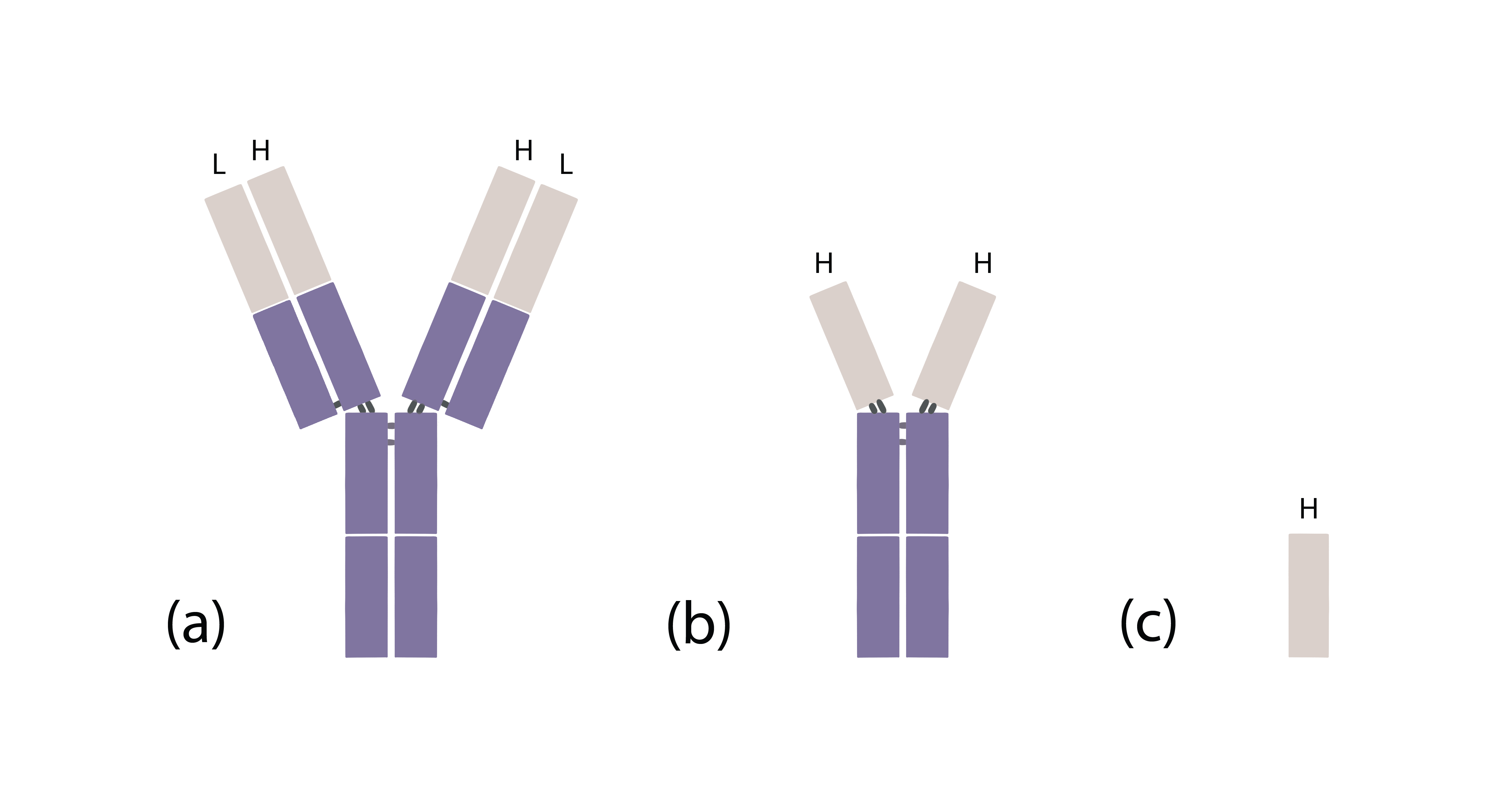
Fig 1: Structures of (a) a conventional antibody, (b) a camelid heavy chain-only antibody, and (c) a nanobody. (L: light chain, H: heavy chain; gray: variable region, purple: constant region)
Author:
Helen Wong, Student Editor, Science Focus, The Hong Kong University of Science and Technology

If you want to unsubscribe our newsletter,
please
reply this e-mail directly.如欲取消訂閱本論壇電子通訊,請直接回覆此電郵。

-
newsletter (Mar 2024 – Issue 24)
關於香港桂冠論壇
歡迎大家來到香港桂冠論壇2024年3月份通訊。
由香港桂冠論壇委員會、Index Game和The Sandbox合辦的「Scientists and Their Contributions立體像素藝術設計比賽」早前已順利舉行,而頒獎禮於3月2日圓滿結束。活動當日,我們很榮幸邀得Index Game營運總監及聯合創辦人王碧琪小姐、The Sandbox香港業務增長主管黃宏誠先生、香港資優教育學苑院長黃金耀博士以及香港桂冠論壇委員會主席唐偉章教授, BBS, JP擔任頒獎嘉賓,一同嘉許參賽隊伍。冠、亞及季軍隊伍分別來自棉紡會中學、港大同學會書院和福建中學,他們於頒獎禮期間向大家分享獲獎感受及參賽得著,包括如何與隊員分工合作、製作時遇到的挑戰、如何能提高作品的像真度等等,而冠軍隊伍亦談及於Index Game實習兩天的體會,並分享了立體像素藝術設計員的日常工作。是次比賽吸引來自11間中學一共21隊的學生參加比賽,他們於短短兩個月內由參加設計軟件工作坊以至製成自己的作品,實在不容易,頒獎嘉賓均對各隊的努力和付出,予以肯定及讚賞。冠、亞及季軍隊伍的作品已上載至我們的網站,歡迎大家按此欣賞!而頒獎禮的精華相片及片段亦已上載至我們的圖片庫、影片庫及YouTube頻道,大家請勿錯過!
不經不覺,我們的重點活動「探索新視野」已踏入第三年。今年1月至3月,我們順利舉辦了「探索新視野2024」,為香港高年級中學生安排一連13場的實驗室/企業參觀及分享會,活動吸引來自一共20間學校超過300人參與。學生透過參與活動,與本地科學家/研究團隊交流,從而了解科研團隊的工作環境、實驗室的運作、團隊於研究過程中遇到的困難,以及香港最新的科研項目等。我們很高興不少本地科學家/研究團隊已連續第二年,甚至第三年,支持這項活動,而「探索新視野2024」更首度獲國家重點實驗室支持,學生得以認識國家重點研究項目。同時,我們首次與本地初創企業合作,讓學生了解醫療金屬三維打印的技術及應用。活動的相片及精華片段已上載至我們的圖片庫、影片庫及YouTube頻道,供大家觀看。桂冠論壇衷心感謝各位學生及老師的踴躍參與,亦感謝一眾本地科學家/研究團隊/初創企業的支持,包括:
香港城市大學太赫茲及毫米波國家重點實驗室陳志豪教授及其研究團隊
香港心腦血管健康工程研究中心陳葦恩教授及其研究團隊
香港科技大學生命科學部張曉東教授及其研究團隊
香港中文大學物理系朱明中教授及其研究團隊
香港大學工業及製造系統工程系柯嘉倫教授及其研究團隊
香港中文大學病理解剖及細胞學系鄧銘權教授及其研究團隊
香港大學病理學系黃澤蕾教授及其研究團隊
免疫與感染研究中心研究團隊
科能三維技術(醫療)有限公司研究團隊
香港大學–巴斯德研究中心研究團隊另外,桂冠論壇於去年年底與香港資優教育學苑、百仁基金組成「G3聯盟」,本著「Gifted、Groom及Giving」的理念,致力發掘及培育新一代創科領袖。而聯盟合辦的重點活動—「少年創科達人大獎」現已接受報名,這項比賽旨在為全港對STEAM有興趣之中三至中六學生締造多元互動的平台,讓年輕人展現創意丶發揮想像丶培養批判性思考能力,成為環境、社會和管治(ESG)的青年領袖。「少年創科達人大獎」設有多個獎項,包括「十大創科少年獎」丶「年度最佳創科達人獎」及「提名人獎項」,創科獎得獎者可獲得香港資優教育學苑學員資格丶嘉許證書丶及豐富的獎學金。除此之外,亦會接受一系列培訓。完成培育計劃後,他們更有機會與公眾分享學習和研究成果,邁向科研和創科之路。比賽報名截止時間為4月15日下午5時正,請按此瀏覽詳情。
桂冠論壇期望未來能與更多機構合作,推動香港科學和科技各個領域的教育和交流,孕育更多科研及創科人才。有關更多論壇最新的消息和活動資訊,記得留意我們的網站、社交媒體和下一期通訊!
新研發的高效能電催化二氧化碳還原系統 旨在減碳排放 促進邁向碳中和
背景:全球暖化給人類社會和生態系統持續帶來威脅,而主導氣候變暖的溫室氣體中,佔最主要比重的正是二氧化碳。為應對氣候變化的問題和邁向促進碳中和的目標,香港理工大學(理大)的研究團隊成功研發一套耐久、高選擇性、高效的二氧化碳電還原系統,可以將二氧化碳轉化成具有重要戰略意義的基礎化工原料乙烯,作其他工業用途,以為減低二氧化碳排放提供有效的解決方案。此研究成果已於國際科學期刊《Nature Energy》發表,並於第 48 屆瑞士日內瓦「國際發明展」獲得金獎。
乙烯(C2H4)是石油化工行業最重要的基礎原料,主要應用於製造聚合物等高分子材料,這些高分子材料可以製造日常使用的塑膠、化纖等。生產乙烯目前仍然主要依賴石化資源,製造過程碳排放高。
通過阻斷碳酸鹽的形成來實現電催化二氧化碳還原製備乙烯之耐久系統
簡介:在應對氣候變化的工作上,尋找減低二氧化碳排放的有效方法十分重要。使用可再生能源進行電催化二氧化碳還原(ECO2R)已成為一項極具前景的解決方案。但是,在這個 ECO2R 過程中,鹼性條件和鹼性陽離子的存在引起了一些難度,以致阻礙這種技術的發展。我們正探索採用一種突破性的純水膜電極組 (MEA) 系統,來克服上述障礙,為得出更為穩定、效率更高的 ECO2R 過程而創造條件。
對於應對氣候變化,有效地減少二氧化碳排放極為重要。雖然採用可再生能源來實現 ECO2R 過程大有可為,但當中涉及的鹼性條件和鹼性陽離子帶來了一些難題。我們的純水膜電極組系統能夠克服這些困難,為得出穩定、高效的 ECO2R 過程創造條件。
作者︰
香港理工大學納米材料講座教授兼應用物理學系系主任劉樹平教授
透過改善腸道微生態紓緩新冠肺炎長期綜合後遺症:目前的研究進展
新冠肺炎長期綜合後遺症是指新冠病毒感染後長期持續而影響多個器官的症狀,又稱「長新冠」。長新冠影響全球超過6,500萬人,但仍缺乏有效的治療方法。香港中文大學醫學院的研究團隊完成了一項大型的雙盲、隨機、安慰劑對照臨床研究,證實患者透過服用香港中文大學研發的口服合生製劑(SIM01)有效紓緩多種長新冠症狀。研究結果已於全球權威醫學期刊《刺針傳染病學》(The Lancet Infectious Diseases)及去年十一月之首屆香港桂冠論壇上發表。
中大醫學院早期研究指出腸道微生態失衡與長新冠密切相關,但全球未有研究證實改善腸道微生態能紓緩長新冠症狀。SIM01是香港中文大學的專利配方,研究團隊借助大數據和機器學習,為不同的疾病研發益菌及益生元組合。在這項名為RECOVERY的大型雙盲、隨機、安慰劑對照的臨床研究中,研究團隊評估了SIM01配方能否紓緩長新冠症狀。團隊在2021至2022年共招募463名新冠康復者參與RECOVERY研究。參加者平均年齡49歲,當中女性佔65%,約70%是Omicron個案,其他為較早的個案。參加者平均於新冠確診四個月後參與研究,他們被隨機分成SIM01組及安慰劑組,兩組人數各佔約一半。其中,SIM01組服用了SIM01六個月,而對照組則服用含有維他命C的安慰劑六個月。
作者︰
香港中文大學醫學院內科及藥物治療學系博士研究生劉曉霖
羊駝與奈米抗體
談及羊駝,我們通常會想到假日農場或羊駝絨,但如果你問生物醫學範疇的科學家的話,他們卻可能會想起一種特殊抗體的片段 — 奈米抗體。
要明白奈米抗體的特殊之處,我們須先了解抗體的結構(圖一)。傳統抗體是由兩條重鏈和兩條輕鏈通過二硫鍵連接形成的 Y 形分子。Y形抗體的兩個尖端稱為可變區,負責與目標抗原結合。一如其名,可變區可以有不同的變化,它們決定抗體與甚麼抗原結合。除傳統抗體外,羊駝、駱駝和駱馬等駱駝科動物也會製造一種僅由兩條重鏈組成的特殊抗體,而奈米抗體就是這些特殊抗體的可變區。
圖一: (a) 傳統抗體、(b) 駱駝科動物只有重鏈的抗體及(c) 奈米抗體(L:輕鏈、H:重鏈、灰色:可變區、紫色:恆定區)
作者︰
香港科技大學《科言》學生編輯王思齊
If you want to unsubscribe our newsletter,
please
reply this e-mail directly.如欲取消訂閱本論壇電子通訊,請直接回覆此電郵。
-
newsletter (Mar 2024 – Issue 24)
关于香港桂冠论坛
欢迎大家来到香港桂冠论坛2024年3月份通讯。
由香港桂冠论坛委员会、Index Game和The Sandbox合办的「Scientists and Their Contributions立体像素艺术设计比赛」早前已顺利举行,而颁奖礼于3月2日圆满结束。活动当日,我们很荣幸邀得Index Game营运总监及联合创办人王碧琪小姐、The Sandbox香港业务增长主管黄宏诚先生、香港资优教育学苑院长黄金耀博士以及香港桂冠论坛委员会主席唐伟章教授, BBS, JP担任颁奖嘉宾,一同嘉许参赛队伍。冠、亚及季军队伍分别来自棉纺会中学、港大同学会书院和福建中学,他们于颁奖礼期间向大家分享获奖感受及参赛得著,包括如何与队员分工合作、制作时遇到的挑战、如何能提高作品的像真度等等,而冠军队伍亦谈及于Index Game实习两天的体会,并分享了立体像素艺术设计员的日常工作。是次比赛吸引来自11间中学一共21队的学生参加比赛,他们于短短两个月内由参加设计软件工作坊以至制成自己的作品,实在不容易,颁奖嘉宾均对各队的努力和付出,予以肯定及赞赏。冠、亚及季军队伍的作品已上载至我们的网站,欢迎大家按此欣赏!而颁奖礼的精华相片及片段亦已上载至我们的图片库、影片库及YouTube频道,大家请勿错过!
不经不觉,我们的重点活动「探索新视野」已踏入第三年。今年1月至3月,我们顺利举办了「探索新视野2024」,为香港高年级中学生安排一连13场的实验室/企业参观及分享会,活动吸引来自一共20间学校超过300人参与。学生透过参与活动,与本地科学家/研究团队交流,从而了解科研团队的工作环境、实验室的运作、团队于研究过程中遇到的困难,以及香港最新的科研项目等。我们很高兴不少本地科学家/研究团队已连续第二年,甚至第三年,支持这项活动,而「探索新视野2024」更首度获国家重点实验室支持,学生得以认识国家重点研究项目。同时,我们首次与本地初创企业合作,让学生了解医疗金属三维打印的技术及应用。活动的相片及精华片段已上载至我们的图片库、影片库及YouTube频道,供大家观看。桂冠论坛衷心感谢各位学生及老师的踊跃参与,亦感谢一众本地科学家/研究团队/初创企业的支持,包括:
香港城市大学太赫兹及毫米波国家重点实验室陈志豪教授及其研究团队
香港心脑血管健康工程研究中心陈苇恩教授及其研究团队
香港科技大学生命科学部张晓东教授及其研究团队
香港中文大学物理系朱明中教授及其研究团队
香港大学工业及制造系统工程系柯嘉伦教授及其研究团队
香港中文大学病理解剖及细胞学系邓铭权教授及其研究团队
香港大学病理学系黄泽蕾教授及其研究团队
免疫与感染研究中心研究团队
科能三维技术(医疗)有限公司研究团队
香港大学–巴斯德研究中心研究团队另外,桂冠论坛于去年年底与香港资优教育学苑、百仁基金组成「G3联盟」,本著「Gifted、Groom及Giving」的理念,致力发掘及培育新一代创科领袖。而联盟合办的重点活动—「少年创科达人大奖」现已接受报名,这项比赛旨在为全港对STEAM有兴趣之中三至中六学生缔造多元互动的平台,让年轻人展现创意丶发挥想像丶培养批判性思考能力,成为环境、社会和管治(ESG)的青年领袖。「少年创科达人大奖」设有多个奖项,包括「十大创科少年奖」丶「年度最佳创科达人奖」及「提名人奖项」,创科奖得奖者可获得香港资优教育学苑学员资格丶嘉许证书丶及丰富的奖学金。除此之外,亦会接受一系列培训。完成培育计划后,他们更有机会与公众分享学习和研究成果,迈向科研和创科之路。比赛报名截止时间为4月15日下午5时正,请按此浏览详情。
桂冠论坛期望未来能与更多机构合作,推动香港科学和科技各个领域的教育和交流,孕育更多科研及创科人才。有关更多论坛最新的消息和活动资讯,记得留意我们的网站、社交媒体和下一期通讯!
新研发的高效能电催化二氧化碳还原系统 旨在减碳排放 促进迈向碳中和
背景:全球暖化给人类社会和生态系统持续带来威胁,而主导气候变暖的温室气体中,占最主要比重的正是二氧化碳。为应对气候变化的问题和迈向促进碳中和的目标,香港理工大学(理大)的研究团队成功研发一套耐久、高选择性、高效的二氧化碳电还原系统,可以将二氧化碳转化成具有重要战略意义的基础化工原料乙烯,作其他工业用途,以为减低二氧化碳排放提供有效的解决方案。此研究成果已于国际科学期刊《Nature Energy》发表,并于第 48 届瑞士日内瓦「国际发明展」获得金奖。
乙烯(C2H4)是石油化工行业最重要的基础原料,主要应用于制造聚合物等高分子材料,这些高分子材料可以制造日常使用的塑胶、化纤等。生产乙烯目前仍然主要依赖石化资源,制造过程碳排放高。
通过阻断碳酸盐的形成来实现电催化二氧化碳还原制备乙烯之耐久系统
简介:在应对气候变化的工作上,寻找减低二氧化碳排放的有效方法十分重要。使用可再生能源进行电催化二氧化碳还原(ECO2R)已成为一项极具前景的解决方案。但是,在这个 ECO2R 过程中,碱性条件和碱性阳离子的存在引起了一些难度,以致阻碍这种技术的发展。我们正探索采用一种突破性的纯水膜电极组 (MEA) 系统,来克服上述障碍,为得出更为稳定、效率更高的 ECO2R 过程而创造条件。
对于应对气候变化,有效地减少二氧化碳排放极为重要。虽然采用可再生能源来实现 ECO2R 过程大有可为,但当中涉及的碱性条件和碱性阳离子带来了一些难题。我们的纯水膜电极组系统能够克服这些困难,为得出稳定、高效的 ECO2R 过程创造条件。
作者︰
香港理工大学纳米材料讲座教授兼应用物理学系系主任刘树平教授
透过改善肠道微生态纾缓新冠肺炎长期综合后遗症:目前的研究进展
新冠肺炎长期综合后遗症是指新冠病毒感染后长期持续而影响多个器官的症状,又称「长新冠」。长新冠影响全球超过6,500万人,但仍缺乏有效的治疗方法。香港中文大学医学院的研究团队完成了一项大型的双盲、随机、安慰剂对照临床研究,证实患者透过服用香港中文大学研发的口服合生制剂(SIM01)有效纾缓多种长新冠症状。研究结果已于全球权威医学期刊《刺针传染病学》(The Lancet Infectious Diseases)及去年十一月之首届香港桂冠论坛上发表。
中大医学院早期研究指出肠道微生态失衡与长新冠密切相关,但全球未有研究证实改善肠道微生态能纾缓长新冠症状。SIM01是香港中文大学的专利配方,研究团队借助大数据和机器学习,为不同的疾病研发益菌及益生元组合。在这项名为RECOVERY的大型双盲、随机、安慰剂对照的临床研究中,研究团队评估了SIM01配方能否纾缓长新冠症状。团队在2021至2022年共招募463名新冠康复者参与RECOVERY研究。参加者平均年龄49岁,当中女性占65%,约70%是Omicron个案,其他为较早的个案。参加者平均于新冠确诊四个月后参与研究,他们被随机分成SIM01组及安慰剂组,两组人数各占约一半。其中,SIM01组服用了SIM01六个月,而对照组则服用含有维他命C的安慰剂六个月。
作者︰
香港中文大学医学院内科及药物治疗学系博士研究生刘晓霖
羊驼与奈米抗体
谈及羊驼,我们通常会想到假日农场或羊驼绒,但如果你问生物医学范畴的科学家的话,他们却可能会想起一种特殊抗体的片段 — 奈米抗体。
要明白奈米抗体的特殊之处,我们须先了解抗体的结构(图一)。传统抗体是由两条重链和两条轻链通过二硫键连接形成的 Y 形分子。Y形抗体的两个尖端称为可变区,负责与目标抗原结合。一如其名,可变区可以有不同的变化,它们决定抗体与甚么抗原结合。除传统抗体外,羊驼、骆驼和骆马等骆驼科动物也会制造一种仅由两条重链组成的特殊抗体,而奈米抗体就是这些特殊抗体的可变区。
图一: (a) 传统抗体、(b) 骆驼科动物只有重链的抗体及(c) 奈米抗体(L:轻链、H:重链、灰色:可变区、紫色:恒定区)
作者︰
香港科技大学《科言》学生编辑王思齐
If you want to unsubscribe our newsletter,
please
reply this e-mail directly.如欲取消訂閱本論壇電子通訊,請直接回覆此電郵。
-
newsletter (Mar 2024 – Issue 24)
About the Hong Kong Laureate Forum
Welcome to the March 2024 issue of the newsletter of the Hong Kong Laureate Forum!
The “Scientists and Their Contributions Voxel Art Design Contest”, jointly organised by the Council of the Hong Kong Laureate Forum (“the HKLF”), Index Game and The Sandbox, was staged and the award presentation ceremony concluded successfully on 2 March. We were honoured to have Ms Becky Wong, Chief Operation Officer and Co-founder of Index Game, Mr Erich Wong, Head of Growth (Hong Kong) of The Sandbox, Dr Jimmy Wong, Executive Director of the Hong Kong Academy of Gifted Education (HKAGE), and Prof Timothy Tong, BBS, JP, Chairman of the HKLF, to commend the participating teams. The Champion, 1st Runner-up and 2nd Runner-up teams were from Cotton Spinners Association Secondary School, Hong Kong University Graduate Association College and Fukien Secondary School respectively. These teams shared with the audience their experience and insights gained in the contest, including how they collaborated with their team members, the challenges they encountered during the production process, and how to enhance the likeness of their work. Members of the Champion team also talked about their experience in the two-day internship at Index Game, offering a glimpse of the daily work of a voxel art designer. The contest attracted 21 teams of students from 11 secondary schools. It was impressive that the participating teams went from attending the design software workshops to creating their own work in just two months. The award presenters recognised and appreciated the efforts and dedication of all participating teams. The masterpieces of the Champion, 1st Runner-up and 2nd Runner-up teams are now available on our website for everyone to visit. In addition, photos and highlights of the award presentation ceremony have been uploaded onto our photo gallery, video gallery and YouTube channel. Make sure you don’t miss the remarkable moments of the ceremony!
Time flies. Our signature event, “Exploring New Horizons”, has entered its third year. From January to March this year, we successfully organised “Exploring New Horizons 2024” – a series of 13 laboratory / enterprise visits along with sharing sessions specifically designed for senior secondary students in Hong Kong. The event garnered participation from over 300 individuals across 20 schools. The participating students had opportunities to interact with local scientists / research teams and delve into their work environment, laboratory operation, challenges faced by the research teams, and the latest scientific research projects in Hong Kong. We are delighted that a number of local scientists / research teams have supported this event for the second, or even the third consecutive year. Moreover, we are proud to announce that “Exploring New Horizons 2024” received support from a state key laboratory for the first time. This significant endorsement created opportunities for students to gain exposure to national key research projects. Also, we embarked on a collaboration with a local start-up, introducing students to medical metal 3D printing technology and application. The event photos and captivating highlights have been uploaded to our photo gallery, video gallery and YouTube channel and please enjoy! The HKLF extends its heartfelt gratitude to the enthusiastic participation of all students and teachers and the support of the local scientists / research teams / start-ups. They include:
Prof Chan Chi Hou and his research team from State Key Laboratory of Terahertz and Millimeter Waves (City University of Hong Kong)
Prof Kannie Chan and her research team from Hong Kong Centre for Cerebro-Cardiovascular Health Engineering
Prof Tom Cheung and his research team from the Division of Life Science of The Hong Kong University of Science and Technology
Prof Chu Ming-chung and his research team from the Department of Physics of the Chinese University of Hong Kong
Dr Calvin Or and his research team from the Department of Industrial & Manufacturing Systems Engineering of the University of Hong Kong
Prof Patrick Tang and his research team from the Department of Anatomical and Cellular Pathology of the Chinese University of Hong Kong
Prof Carmen Wong and her research team from the Department of Pathology of the University of Hong Kong
Research team from Centre for Immunology & Infection
Research team from Koln 3D Technology (Medical) Limited
Research team from the University of Hong Kong – Pasteur Research PoleFurthermore, the HKLF forged ‘G3 Alliance’, with HKAGE and Centum Charitas Foundation at the end of last year. Under the principles of ‘Gifted, Groom and Giving’, the alliance aims to identify and nurture the next generation of innovation and technology leaders. Its key event, the “Young STEAM Talent Award”, is now open for registration. This Award is an initiative to create a dynamic platform for Secondary 3 to 6 students in Hong Kong who are keen on STEAM to showcase their creativity, unleash their imaginative ideas and cultivate critical thinking abilities, so as to emerge as leaders in the realms of environmental, social, and governance (ESG) practices. This Award consists of numerous awards and prizes, including “Top Ten Young STEAM Talents Award”, “Young STEAM Talent of the Year Award” and “Nominator of the Award winners”. Young STEAM Talent Award winners will be entitled the HKAGE membership as well as receive a commendation certificate and scholarship. They will also be joining a well-structured nurturing programme. After the completion of the programme, they will have opportunities to share with the public their learning and research outcomes, paving their ways to scientific research and innovation. The registration deadline for the Award is 15 April 5:00pm. Please visit here for more information.
The HKLF looks forward to future collaborations with more organisations to promote education and exchanges in various disciplines in science and technology in Hong Kong, incubating more scientific research and innovation talents. For the latest news and our upcoming events, stay tuned to our website, social media and the next newsletter!
The Newly Developed High-Efficiency Carbon Dioxide Electroreduction System Targets to Reduce Carbon Footprint and Progress Carbon Neutrality Goals
Background: Global warming continues to pose a threat to human society and the ecological systems, and carbon dioxide accounts for the largest proportion of the greenhouse gases that dominate climate warming. To combat climate change and move towards the goal of carbon neutrality, researchers from The Hong Kong Polytechnic University have developed a durable, highly selective and energy-efficient carbon dioxide (CO2) electroreduction system that can convert CO2 into ethylene for industrial purposes to provide an effective solution for reducing CO2 emissions. This research was recently published in Nature Energy and won a Gold Medal at the 48th International Exhibition of Inventions Geneva in Switzerland.
Ethylene (C2H4) is one of the most in-demand chemicals globally and is mainly used in the manufacture of polymers such as polyethylene, which, in turn, can be used to make plastics and chemical fibres commonly used in daily life. However, it is still mostly obtained from petrochemical sources and the production process involves the creation of a very significant carbon footprint.
Durable Electrocatalytic CO2 Reduction to Ethylene System via Eliminating Carbonate Formation
Introduction: In the fight against climate change, finding efficient ways to reduce CO2 emissions is crucial. Electrocatalytic CO2 reduction (ECO2R) using renewable energy sources has emerged as a promising solution. However, the presence of alkaline conditions and alkali cations during ECO2R poses challenges, hindering the development of this technology. We explore a groundbreaking pure-water-fed membrane-electrode-assembly (MEA) system that overcomes these obstacles, paving the way for a more stable and efficient ECO2R process.
Efficient CO2 reduction is crucial in fighting climate change. ECO2R with renewable energy is promising, but alkaline conditions and alkali cations pose challenges. Our pure-water-fed MEA system overcomes these, paving the way for a stable and efficient ECO2R process.
Author:
Prof Daniel Lau, Chair Professor of Nanomaterials and Head of the Department of Applied Physics, The Hong Kong Polytechnic University
Gut Microbiota Modulation for Post-Acute COVID-19 Syndrome: Current Evidence
Post-acute COVID-19 syndrome (“long COVID”) refers to long-term symptoms that persist after acute SARS-CoV-2 infection, affecting multiple organs and systems. Long COVID affects over 65 million people worldwide, yet effective treatment is limited. Our research team at the Faculty of Medicine of the Chinese University of Hong Kong (CUHK Medicine) has completed a large-scale double-blind, randomised, placebo-controlled clinical trial, which confirmed that patients who were given an oral synbiotic preparation (SIM01) developed by CUHK experienced significant alleviation in various long COVID symptoms. The landmark findings have been published in the world-leading journal in infectious diseases, The Lancet Infectious Diseases, and presented at the inaugural Hong Kong Laureate Forum in November 2023.
Earlier studies by CUHK Medicine showed close associations between gut microbiota dysbiosis and long COVID. However, no research has yet to confirm that gut microbiota modulation could alleviate long COVID symptoms. SIM01 is a patented oral synbiotic formula developed by CUHK Medicine, who has been keen to utilise big data and machine learning to develop synbiotic formulae of beneficial probiotics and prebiotics for different diseases. In this large-scale double-blind, randomised, placebo-controlled clinical study (RECOVERY), our team have evaluated whether SIM01 could alleviate long COVID symptoms. In 2021 to 2022, we have recruited a total of 463 recovered COVID-19 patients to participate in the RECOVERY trial. Participants’ mean age was 49 years, and 65% were female. Nearly 70% of participants were Omicron cases, whilst others were earlier cases. They were enrolled into the study at a median of 4 months after COVID-19 diagnosis and were randomly assigned either into the SIM01 group or the control group at 1:1 ratio. The SIM01 group received SIM01 orally for 6 months, whilst the control group received placebo containing vitamin C orally for 6 months.
Author:
Ms Raphaela Iris Lau, Hong Kong PhD Fellow, Department of Medicine and Therapeutics, Faculty of Medicine, The Chinese University of Hong Kong
Alpacas and Nanobodies
When we think of alpacas, the first things that pop up in our minds may be holiday farms or alpaca fleece. However, if you ask a biomedical scientist, they may have thought of nanobody, fragment of a special type of antibody.
To appreciate why nanobodies are so special, we must first understand what an antibody looks like (Fig 1). A conventional antibody is composed of two heavy chains and two light chains. These chains are joined by disulfide bonds to form a Y-shaped molecule. The two tips of the Y-shaped antibody are called variable regions, which are responsible for binding to a target antigen. Variable regions of antibodies literally vary greatly and they determine what antigen an antibody will bind to. In addition to conventional antibodies, members of the camelid family, such as alpacas, camels and llamas, also produce a special type of antibody that only consists of two heavy chains. Nanobodies are the variable regions of these special antibodies.
Fig 1: Structures of (a) a conventional antibody, (b) a camelid heavy chain-only antibody, and (c) a nanobody. (L: light chain, H: heavy chain; gray: variable region, purple: constant region)
Author:
Helen Wong, Student Editor, Science Focus, The Hong Kong University of Science and Technology
If you want to unsubscribe our newsletter,
please
reply this e-mail directly.如欲取消訂閱本論壇電子通訊,請直接回覆此電郵。
-
newsletter (Mar 2024 – Issue 24)
關於香港桂冠論壇
歡迎大家來到香港桂冠論壇2024年3月份通訊。
由香港桂冠論壇委員會、Index Game和The Sandbox合辦的「Scientists and Their Contributions立體像素藝術設計比賽」早前已順利舉行,而頒獎禮於3月2日圓滿結束。活動當日,我們很榮幸邀得Index Game營運總監及聯合創辦人王碧琪小姐、The Sandbox香港業務增長主管黃宏誠先生、香港資優教育學苑院長黃金耀博士以及香港桂冠論壇委員會主席唐偉章教授, BBS, JP擔任頒獎嘉賓,一同嘉許參賽隊伍。冠、亞及季軍隊伍分別來自棉紡會中學、港大同學會書院和福建中學,他們於頒獎禮期間向大家分享獲獎感受及參賽得著,包括如何與隊員分工合作、製作時遇到的挑戰、如何能提高作品的像真度等等,而冠軍隊伍亦談及於Index Game實習兩天的體會,並分享了立體像素藝術設計員的日常工作。是次比賽吸引來自11間中學一共21隊的學生參加比賽,他們於短短兩個月內由參加設計軟件工作坊以至製成自己的作品,實在不容易,頒獎嘉賓均對各隊的努力和付出,予以肯定及讚賞。冠、亞及季軍隊伍的作品已上載至我們的網站,歡迎大家按此欣賞!而頒獎禮的精華相片及片段亦已上載至我們的圖片庫、影片庫及YouTube頻道,大家請勿錯過!
不經不覺,我們的重點活動「探索新視野」已踏入第三年。今年1月至3月,我們順利舉辦了「探索新視野2024」,為香港高年級中學生安排一連13場的實驗室/企業參觀及分享會,活動吸引來自一共20間學校超過300人參與。學生透過參與活動,與本地科學家/研究團隊交流,從而了解科研團隊的工作環境、實驗室的運作、團隊於研究過程中遇到的困難,以及香港最新的科研項目等。我們很高興不少本地科學家/研究團隊已連續第二年,甚至第三年,支持這項活動,而「探索新視野2024」更首度獲國家重點實驗室支持,學生得以認識國家重點研究項目。同時,我們首次與本地初創企業合作,讓學生了解醫療金屬三維打印的技術及應用。活動的相片及精華片段已上載至我們的圖片庫、影片庫及YouTube頻道,供大家觀看。桂冠論壇衷心感謝各位學生及老師的踴躍參與,亦感謝一眾本地科學家/研究團隊/初創企業的支持,包括:
香港城市大學太赫茲及毫米波國家重點實驗室陳志豪教授及其研究團隊
香港心腦血管健康工程研究中心陳葦恩教授及其研究團隊
香港科技大學生命科學部張曉東教授及其研究團隊
香港中文大學物理系朱明中教授及其研究團隊
香港大學工業及製造系統工程系柯嘉倫教授及其研究團隊
香港中文大學病理解剖及細胞學系鄧銘權教授及其研究團隊
香港大學病理學系黃澤蕾教授及其研究團隊
免疫與感染研究中心研究團隊
科能三維技術(醫療)有限公司研究團隊
香港大學–巴斯德研究中心研究團隊另外,桂冠論壇於去年年底與香港資優教育學苑、百仁基金組成「G3聯盟」,本著「Gifted、Groom及Giving」的理念,致力發掘及培育新一代創科領袖。而聯盟合辦的重點活動—「少年創科達人大獎」現已接受報名,這項比賽旨在為全港對STEAM有興趣之中三至中六學生締造多元互動的平台,讓年輕人展現創意丶發揮想像丶培養批判性思考能力,成為環境、社會和管治(ESG)的青年領袖。「少年創科達人大獎」設有多個獎項,包括「十大創科少年獎」丶「年度最佳創科達人獎」及「提名人獎項」,創科獎得獎者可獲得香港資優教育學苑學員資格丶嘉許證書丶及豐富的獎學金。除此之外,亦會接受一系列培訓。完成培育計劃後,他們更有機會與公眾分享學習和研究成果,邁向科研和創科之路。比賽報名截止時間為4月15日下午5時正,請按此瀏覽詳情。
桂冠論壇期望未來能與更多機構合作,推動香港科學和科技各個領域的教育和交流,孕育更多科研及創科人才。有關更多論壇最新的消息和活動資訊,記得留意我們的網站、社交媒體和下一期通訊!
新研發的高效能電催化二氧化碳還原系統 旨在減碳排放 促進邁向碳中和
背景:全球暖化給人類社會和生態系統持續帶來威脅,而主導氣候變暖的溫室氣體中,佔最主要比重的正是二氧化碳。為應對氣候變化的問題和邁向促進碳中和的目標,香港理工大學(理大)的研究團隊成功研發一套耐久、高選擇性、高效的二氧化碳電還原系統,可以將二氧化碳轉化成具有重要戰略意義的基礎化工原料乙烯,作其他工業用途,以為減低二氧化碳排放提供有效的解決方案。此研究成果已於國際科學期刊《Nature Energy》發表,並於第 48 屆瑞士日內瓦「國際發明展」獲得金獎。
乙烯(C2H4)是石油化工行業最重要的基礎原料,主要應用於製造聚合物等高分子材料,這些高分子材料可以製造日常使用的塑膠、化纖等。生產乙烯目前仍然主要依賴石化資源,製造過程碳排放高。
通過阻斷碳酸鹽的形成來實現電催化二氧化碳還原製備乙烯之耐久系統
簡介:在應對氣候變化的工作上,尋找減低二氧化碳排放的有效方法十分重要。使用可再生能源進行電催化二氧化碳還原(ECO2R)已成為一項極具前景的解決方案。但是,在這個 ECO2R 過程中,鹼性條件和鹼性陽離子的存在引起了一些難度,以致阻礙這種技術的發展。我們正探索採用一種突破性的純水膜電極組 (MEA) 系統,來克服上述障礙,為得出更為穩定、效率更高的 ECO2R 過程而創造條件。
對於應對氣候變化,有效地減少二氧化碳排放極為重要。雖然採用可再生能源來實現 ECO2R 過程大有可為,但當中涉及的鹼性條件和鹼性陽離子帶來了一些難題。我們的純水膜電極組系統能夠克服這些困難,為得出穩定、高效的 ECO2R 過程創造條件。
作者︰
香港理工大學納米材料講座教授兼應用物理學系系主任劉樹平教授
透過改善腸道微生態紓緩新冠肺炎長期綜合後遺症:目前的研究進展
新冠肺炎長期綜合後遺症是指新冠病毒感染後長期持續而影響多個器官的症狀,又稱「長新冠」。長新冠影響全球超過6,500萬人,但仍缺乏有效的治療方法。香港中文大學醫學院的研究團隊完成了一項大型的雙盲、隨機、安慰劑對照臨床研究,證實患者透過服用香港中文大學研發的口服合生製劑(SIM01)有效紓緩多種長新冠症狀。研究結果已於全球權威醫學期刊《刺針傳染病學》(The Lancet Infectious Diseases)及去年十一月之首屆香港桂冠論壇上發表。
中大醫學院早期研究指出腸道微生態失衡與長新冠密切相關,但全球未有研究證實改善腸道微生態能紓緩長新冠症狀。SIM01是香港中文大學的專利配方,研究團隊借助大數據和機器學習,為不同的疾病研發益菌及益生元組合。在這項名為RECOVERY的大型雙盲、隨機、安慰劑對照的臨床研究中,研究團隊評估了SIM01配方能否紓緩長新冠症狀。團隊在2021至2022年共招募463名新冠康復者參與RECOVERY研究。參加者平均年齡49歲,當中女性佔65%,約70%是Omicron個案,其他為較早的個案。參加者平均於新冠確診四個月後參與研究,他們被隨機分成SIM01組及安慰劑組,兩組人數各佔約一半。其中,SIM01組服用了SIM01六個月,而對照組則服用含有維他命C的安慰劑六個月。
作者︰
香港中文大學醫學院內科及藥物治療學系博士研究生劉曉霖
羊駝與奈米抗體
談及羊駝,我們通常會想到假日農場或羊駝絨,但如果你問生物醫學範疇的科學家的話,他們卻可能會想起一種特殊抗體的片段 — 奈米抗體。
要明白奈米抗體的特殊之處,我們須先了解抗體的結構(圖一)。傳統抗體是由兩條重鏈和兩條輕鏈通過二硫鍵連接形成的 Y 形分子。Y形抗體的兩個尖端稱為可變區,負責與目標抗原結合。一如其名,可變區可以有不同的變化,它們決定抗體與甚麼抗原結合。除傳統抗體外,羊駝、駱駝和駱馬等駱駝科動物也會製造一種僅由兩條重鏈組成的特殊抗體,而奈米抗體就是這些特殊抗體的可變區。
圖一: (a) 傳統抗體、(b) 駱駝科動物只有重鏈的抗體及(c) 奈米抗體(L:輕鏈、H:重鏈、灰色:可變區、紫色:恆定區)
作者︰
香港科技大學《科言》學生編輯王思齊
If you want to unsubscribe our newsletter,
please
reply this e-mail directly.如欲取消訂閱本論壇電子通訊,請直接回覆此電郵。
-
newsletter (Mar 2024 – Issue 24)
关于香港桂冠论坛
欢迎大家来到香港桂冠论坛2024年3月份通讯。
由香港桂冠论坛委员会、Index Game和The Sandbox合办的「Scientists and Their Contributions立体像素艺术设计比赛」早前已顺利举行,而颁奖礼于3月2日圆满结束。活动当日,我们很荣幸邀得Index Game营运总监及联合创办人王碧琪小姐、The Sandbox香港业务增长主管黄宏诚先生、香港资优教育学苑院长黄金耀博士以及香港桂冠论坛委员会主席唐伟章教授, BBS, JP担任颁奖嘉宾,一同嘉许参赛队伍。冠、亚及季军队伍分别来自棉纺会中学、港大同学会书院和福建中学,他们于颁奖礼期间向大家分享获奖感受及参赛得著,包括如何与队员分工合作、制作时遇到的挑战、如何能提高作品的像真度等等,而冠军队伍亦谈及于Index Game实习两天的体会,并分享了立体像素艺术设计员的日常工作。是次比赛吸引来自11间中学一共21队的学生参加比赛,他们于短短两个月内由参加设计软件工作坊以至制成自己的作品,实在不容易,颁奖嘉宾均对各队的努力和付出,予以肯定及赞赏。冠、亚及季军队伍的作品已上载至我们的网站,欢迎大家按此欣赏!而颁奖礼的精华相片及片段亦已上载至我们的图片库、影片库及YouTube频道,大家请勿错过!
不经不觉,我们的重点活动「探索新视野」已踏入第三年。今年1月至3月,我们顺利举办了「探索新视野2024」,为香港高年级中学生安排一连13场的实验室/企业参观及分享会,活动吸引来自一共20间学校超过300人参与。学生透过参与活动,与本地科学家/研究团队交流,从而了解科研团队的工作环境、实验室的运作、团队于研究过程中遇到的困难,以及香港最新的科研项目等。我们很高兴不少本地科学家/研究团队已连续第二年,甚至第三年,支持这项活动,而「探索新视野2024」更首度获国家重点实验室支持,学生得以认识国家重点研究项目。同时,我们首次与本地初创企业合作,让学生了解医疗金属三维打印的技术及应用。活动的相片及精华片段已上载至我们的图片库、影片库及YouTube频道,供大家观看。桂冠论坛衷心感谢各位学生及老师的踊跃参与,亦感谢一众本地科学家/研究团队/初创企业的支持,包括:
香港城市大学太赫兹及毫米波国家重点实验室陈志豪教授及其研究团队
香港心脑血管健康工程研究中心陈苇恩教授及其研究团队
香港科技大学生命科学部张晓东教授及其研究团队
香港中文大学物理系朱明中教授及其研究团队
香港大学工业及制造系统工程系柯嘉伦教授及其研究团队
香港中文大学病理解剖及细胞学系邓铭权教授及其研究团队
香港大学病理学系黄泽蕾教授及其研究团队
免疫与感染研究中心研究团队
科能三维技术(医疗)有限公司研究团队
香港大学–巴斯德研究中心研究团队另外,桂冠论坛于去年年底与香港资优教育学苑、百仁基金组成「G3联盟」,本著「Gifted、Groom及Giving」的理念,致力发掘及培育新一代创科领袖。而联盟合办的重点活动—「少年创科达人大奖」现已接受报名,这项比赛旨在为全港对STEAM有兴趣之中三至中六学生缔造多元互动的平台,让年轻人展现创意丶发挥想像丶培养批判性思考能力,成为环境、社会和管治(ESG)的青年领袖。「少年创科达人大奖」设有多个奖项,包括「十大创科少年奖」丶「年度最佳创科达人奖」及「提名人奖项」,创科奖得奖者可获得香港资优教育学苑学员资格丶嘉许证书丶及丰富的奖学金。除此之外,亦会接受一系列培训。完成培育计划后,他们更有机会与公众分享学习和研究成果,迈向科研和创科之路。比赛报名截止时间为4月15日下午5时正,请按此浏览详情。
桂冠论坛期望未来能与更多机构合作,推动香港科学和科技各个领域的教育和交流,孕育更多科研及创科人才。有关更多论坛最新的消息和活动资讯,记得留意我们的网站、社交媒体和下一期通讯!
新研发的高效能电催化二氧化碳还原系统 旨在减碳排放 促进迈向碳中和
背景:全球暖化给人类社会和生态系统持续带来威胁,而主导气候变暖的温室气体中,占最主要比重的正是二氧化碳。为应对气候变化的问题和迈向促进碳中和的目标,香港理工大学(理大)的研究团队成功研发一套耐久、高选择性、高效的二氧化碳电还原系统,可以将二氧化碳转化成具有重要战略意义的基础化工原料乙烯,作其他工业用途,以为减低二氧化碳排放提供有效的解决方案。此研究成果已于国际科学期刊《Nature Energy》发表,并于第 48 届瑞士日内瓦「国际发明展」获得金奖。
乙烯(C2H4)是石油化工行业最重要的基础原料,主要应用于制造聚合物等高分子材料,这些高分子材料可以制造日常使用的塑胶、化纤等。生产乙烯目前仍然主要依赖石化资源,制造过程碳排放高。
通过阻断碳酸盐的形成来实现电催化二氧化碳还原制备乙烯之耐久系统
简介:在应对气候变化的工作上,寻找减低二氧化碳排放的有效方法十分重要。使用可再生能源进行电催化二氧化碳还原(ECO2R)已成为一项极具前景的解决方案。但是,在这个 ECO2R 过程中,碱性条件和碱性阳离子的存在引起了一些难度,以致阻碍这种技术的发展。我们正探索采用一种突破性的纯水膜电极组 (MEA) 系统,来克服上述障碍,为得出更为稳定、效率更高的 ECO2R 过程而创造条件。
对于应对气候变化,有效地减少二氧化碳排放极为重要。虽然采用可再生能源来实现 ECO2R 过程大有可为,但当中涉及的碱性条件和碱性阳离子带来了一些难题。我们的纯水膜电极组系统能够克服这些困难,为得出稳定、高效的 ECO2R 过程创造条件。
作者︰
香港理工大学纳米材料讲座教授兼应用物理学系系主任刘树平教授
透过改善肠道微生态纾缓新冠肺炎长期综合后遗症:目前的研究进展
新冠肺炎长期综合后遗症是指新冠病毒感染后长期持续而影响多个器官的症状,又称「长新冠」。长新冠影响全球超过6,500万人,但仍缺乏有效的治疗方法。香港中文大学医学院的研究团队完成了一项大型的双盲、随机、安慰剂对照临床研究,证实患者透过服用香港中文大学研发的口服合生制剂(SIM01)有效纾缓多种长新冠症状。研究结果已于全球权威医学期刊《刺针传染病学》(The Lancet Infectious Diseases)及去年十一月之首届香港桂冠论坛上发表。
中大医学院早期研究指出肠道微生态失衡与长新冠密切相关,但全球未有研究证实改善肠道微生态能纾缓长新冠症状。SIM01是香港中文大学的专利配方,研究团队借助大数据和机器学习,为不同的疾病研发益菌及益生元组合。在这项名为RECOVERY的大型双盲、随机、安慰剂对照的临床研究中,研究团队评估了SIM01配方能否纾缓长新冠症状。团队在2021至2022年共招募463名新冠康复者参与RECOVERY研究。参加者平均年龄49岁,当中女性占65%,约70%是Omicron个案,其他为较早的个案。参加者平均于新冠确诊四个月后参与研究,他们被随机分成SIM01组及安慰剂组,两组人数各占约一半。其中,SIM01组服用了SIM01六个月,而对照组则服用含有维他命C的安慰剂六个月。
作者︰
香港中文大学医学院内科及药物治疗学系博士研究生刘晓霖
羊驼与奈米抗体
谈及羊驼,我们通常会想到假日农场或羊驼绒,但如果你问生物医学范畴的科学家的话,他们却可能会想起一种特殊抗体的片段 — 奈米抗体。
要明白奈米抗体的特殊之处,我们须先了解抗体的结构(图一)。传统抗体是由两条重链和两条轻链通过二硫键连接形成的 Y 形分子。Y形抗体的两个尖端称为可变区,负责与目标抗原结合。一如其名,可变区可以有不同的变化,它们决定抗体与甚么抗原结合。除传统抗体外,羊驼、骆驼和骆马等骆驼科动物也会制造一种仅由两条重链组成的特殊抗体,而奈米抗体就是这些特殊抗体的可变区。
图一: (a) 传统抗体、(b) 骆驼科动物只有重链的抗体及(c) 奈米抗体(L:轻链、H:重链、灰色:可变区、紫色:恒定区)
作者︰
香港科技大学《科言》学生编辑王思齐
If you want to unsubscribe our newsletter,
please
reply this e-mail directly.如欲取消訂閱本論壇電子通訊,請直接回覆此電郵。
