Author: uniquekey

  • 老化 – 所有生命的必然結局?

    老化 – 所有生命的必然結局?

    「老化」是個神秘的過程,而且引發了我們許多疑問。為何生物會老化?為何我們死亡的年齡又各有不同?老化背後又蘊藏著什麼機制?科學家觀察到,一組實驗室小鼠即使基因相同,每隻壽命卻各有不同,令人嘖嘖稱奇…..

    (more…)

  • 老化 – 所有生命的必然结局?

    老化 – 所有生命的必然结局?

    「老化」是个神秘的过程,而且引发了我们许多疑问。为何生物会老化?为何我们死亡的年龄又各有不同?老化背后又蕴藏著什么机制?科学家观察到,一组实验室小鼠即使基因相同,每只寿命却各有不同,令人啧啧称奇…..

    (more…)

  • 科学界女强人 – 激发下一代力量

    科学界女强人 – 激发下一代力量

    The Science Exposition is the first chapter to kick-off the “prelude to the Inaugural Forum” series etc…

    (more…)

  • 科學界女強人 – 激發下一代力量

    科學界女強人 – 激發下一代力量

    The Science Exposition is the first chapter to kick-off the “prelude to the Inaugural Forum” series etc…

    (more…)

  • Wonder Women in Science – Inspiring and Empowering the Next Generation

    Wonder Women in Science – Inspiring and Empowering the Next Generation

    The Science Exposition is the first chapter to kick-off the “prelude to the Inaugural Forum” series etc…

    (more…)

  • newsletter (Jan 2022 – Issue 13)

    newsletter (Jan 2022 – Issue 13)


    关于香港桂冠论坛


    新年快乐!欢迎大家来到香港桂冠论坛2022年1月份通讯。

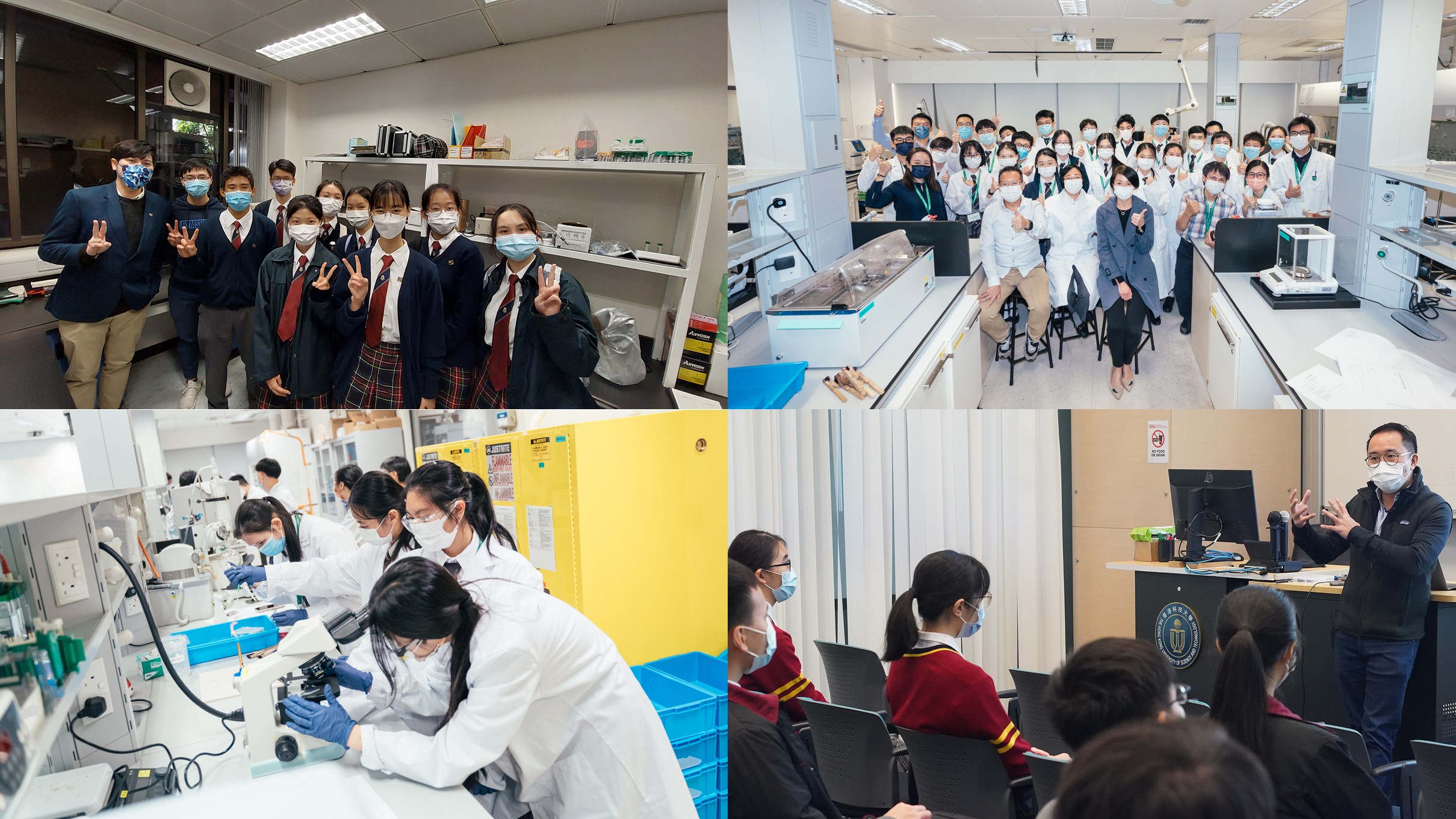
    香港桂冠论坛先后在9至11月期间举办了首届论坛前奏活动的第一和第二个主题活动。而在12月,香港桂冠论坛亦展开了第三个主题活动 – 「探索新视野」。桂冠论坛联同香港本地科学家/研究团队,为香港高年级中学生安排了参观他们的实验室以及进行对谈会。这次活动旨在透过学生亲身体验和提问,从而了解科学家们的现实生活和工作环境、香港最新的科研设施、实验室的运作和科学家们研究过程中经历的起跌等,也借此提升中学生对科研的兴趣。参与的学生和老师对于能够参观香港本地的实验室感到十分高兴,对本地的科研发展状况也了解更多。

    1月份时,香港的新冠疫情反覆,我们很遗憾需取消或延迟部分的参观和对谈会,但香港桂冠论坛十分感谢各位学生和老师把握着机会积极参与,亦十分感谢一众本地科学家/研究团队,继续支持香港桂冠论坛的活动。他们包括香港科技大学生命科学部副教授张晓东教授、香港浸会大学数学系助理教授韩汝星博士、香港都会大学科技学院副教授史东甫博士及香港中文大学病理解剖及细胞学系助理教授邓铭权博士。

    第一至第三个主题活动的精华片段已经上载至我们的网站和YouTube 频道给大家重温。

    除此之外,香港桂冠论坛原定于2022年2月11至14日在香港西九文化区戏曲中心中庭举行一个聚焦女性科学家的展览以及配合「国际妇女节」于2022年3月8日举行的首届桂冠论坛前奏活动第四个主题活动「科学界女强人」,亦因为新冠疫情的发展而需要延期。

    我们将会透过网站和社交媒体公布更多有关香港桂冠论坛活动的安排,大家记得留意!

    最后,虎年将至,香港桂冠论坛祝您虎年大吉,虎气冲天!


    二战以来香港天文台历史


    在香港桂冠论坛 2021年7月份通讯中一篇有关“香港天文台早期历史”的文章中,我们介绍了天文台自开台前后至二战前的历史。现在我们介绍天文台自二战以来的历史与发展。

    战争的考验

    香港在1941年12月8日早上遭到日军侵袭,并最终于1941年12月25日沦陷。香港天文台所有运作被迫停止。在1941年至1945年香港被占领期间,天文台总部的主要用途是操作两门高射炮。从寻回的记录显示,当时日本气象队士兵曾驻守在天文台总部作气象观测。虽然天文台建筑物仅遭受表面损坏,但几乎所有设备都被日军拆除。

    日占香港时期,时任台长伊云士先生(Mr B D Evans)被禁锢于赤柱拘留营,而时任助理台长希活先生和同事史他白先生则被关押在深水埗战俘营。虽然当时环境恶劣和十分艰难,伊云士仍凭借人手及简单仪器,在赤柱拘留营内断断续续地维持部分的天气观测工作,并把收集到的气象数据笔录在帐簿、信纸、香烟包和罐装饼干内附送的动物卡之上。


    作者︰
    香港天文台台长郑楚明博士
    香港天文台前台长岑智明先生
    香港天文台高级科学主任李子祥博士

    2022年1月


    孪生质数猜想与博学者计划


    有些数学问题是常人完全不能理解的,譬如黎曼猜想(Riemann hypothesis)需要用到不少高等数学知识才能解释;可是也有些问题是十岁小孩也能明白的。著名的孪生质数猜想(Twin Prime Conjecture)绝对能被归类为后者。它由Alphonse de Polignac 在19世纪提出,指世界上存在着无限多对相减之差为二的质数,而这些质数因此被称为「孪生」质数(twin primes),例如3和5是一对孪生质数,71和73也是。当数字越来越大,质数出现的频率越来越低。即使如此,我们也能找到一些大得惊人的孪生质数,现时纪录是一对在十进制下有着388,342位的质数2996863034895 × 21290000 – 1和2996863034895 × 21290000 + 1。这不禁让人猜想数字里面可能包括无限对孪生质数,即是无论我们找到的孪生质数有多大,都总有一对会比它们大。

    这猜想本身其实也没什么好说的,但是比较有趣的是近年在这个问题上作出突破所用的方法。大家对数学研究的印象可能是一位数学家坐在房间里独自与问题搏斗,一直把自己锁在房间里直至找到解决方法为止。对孪生质数提出突破性理论的两位数学家 — 张益唐和James MAYNARD的确都是分别独自进行研究,可是另一方面的突破则来自一个公开的大型合作计划 — 博学者计划(Polymath Project)。


    作者︰
    蔡茜珩
    《科言》学生编辑
    香港科技大学

    设计︰
    曾卓希
    《科言》学生设计师
    香港科技大学

    2022年1月


  • newsletter (Jan 2022 – Issue 13)

    newsletter (Jan 2022 – Issue 13)


    關於香港桂冠論壇


    新年快樂!歡迎大家來到香港桂冠論壇2022年1月份通訊。

    香港桂冠論壇先後在9至11月期間舉辦了首屆論壇前奏活動的第一和第二個主題活動。而在12月,香港桂冠論壇亦展開了第三個主題活動 – 「探索新視野」。桂冠論壇聯同香港本地科學家/研究團隊,為香港高年級中學生安排了參觀他們的實驗室以及進行對談會。這次活動旨在透過學生親身體驗和提問,從而了解科學家們的現實生活和工作環境、香港最新的科研設施、實驗室的運作和科學家們研究過程中經歷的起跌等,也藉此提升中學生對科研的興趣。參與的學生和老師對於能夠參觀香港本地的實驗室感到十分高興,對本地的科研發展狀況也了解更多。

    1月份時,香港的新冠疫情反覆,我們很遺憾需取消或延遲部分的參觀和對談會,但香港桂冠論壇十分感謝各位學生和老師把握著機會積極參與,亦十分感謝一眾本地科學家/研究團隊,繼續支持香港桂冠論壇的活動。他們包括香港科技大學生命科學部副教授張曉東教授、香港浸會大學數學系助理教授韓汝星博士、香港都會大學科技學院副教授史東甫博士及香港中文大學病理解剖及細胞學系助理教授鄧銘權博士。

    第一至第三個主題活動的精華片段已經上載至我們的網站和YouTube 頻道給大家重溫。

    除此之外,香港桂冠論壇原定於2022年2月11至14日在香港西九文化區戲曲中心中庭舉行一個聚焦女性科學家的展覽以及配合「國際婦女節」於2022年3月8日舉行的首屆桂冠論壇前奏活動第四個主題活動「科學界女強人」,亦因為新冠疫情的發展而需要延期。

    我們將會透過網站和社交媒體公佈更多有關香港桂冠論壇活動的安排,大家記得留意!

    最後,虎年將至,香港桂冠論壇祝您虎年大吉,虎氣沖天!


    二戰以來香港天文台歷史


    在香港桂冠論壇 2021年7月份通訊中一篇有關“香港天文台早期歷史”的文章中,我們介紹了天文台自開台前後至二戰前的歷史。現在我們介紹天文台自二戰以來的歷史與發展。

    戰爭的考驗

    香港在1941年12月8日早上遭到日軍侵襲,並最終於1941年12月25日淪陷。香港天文台所有運作被迫停止。在1941年至1945年香港被佔領期間,天文台總部的主要用途是操作兩門高射炮。從尋回的記錄顯示,當時日本氣象隊士兵曾駐守在天文台總部作氣象觀測。雖然天文台建築物僅遭受表面損壞,但幾乎所有設備都被日軍拆除。

    日佔香港時期,時任台長伊雲士先生(Mr B D Evans)被禁錮於赤柱拘留營,而時任助理台長希活先生和同事史他白先生則被關押在深水埗戰俘營。雖然當時環境惡劣和十分艱難,伊雲士仍憑藉人手及簡單儀器,在赤柱拘留營內斷斷續續地維持部分的天氣觀測工作,並把收集到的氣象數據筆錄在帳簿、信紙、香煙包和罐裝餅乾內附送的動物卡之上。


    作者︰
    香港天文台台長鄭楚明博士
    香港天文台前台長岑智明先生
    香港天文台高級科學主任李子祥博士

    2022年1月


    孿生質數猜想與博學者計劃


    有些數學問題是常人完全不能理解的,譬如黎曼猜想(Riemann hypothesis)需要用到不少高等數學知識才能解釋;可是也有些問題是十歲小孩也能明白的。著名的孿生質數猜想(Twin Prime Conjecture)絕對能被歸類為後者。它由Alphonse de Polignac 在19世紀提出,指世界上存在著無限多對相減之差為二的質數,而這些質數因此被稱為「孿生」質數(twin primes),例如3和5是一對孿生質數,71和73也是。當數字越來越大,質數出現的頻率越來越低。即使如此,我們也能找到一些大得驚人的孿生質數,現時紀錄是一對在十進制下有著388,342位的質數2996863034895 × 21290000 – 1和2996863034895 × 21290000 + 1。這不禁讓人猜想數字裡面可能包括無限對孿生質數,即是無論我們找到的孿生質數有多大,都總有一對會比它們大。

    這猜想本身其實也沒什麼好說的,但是比較有趣的是近年在這個問題上作出突破所用的方法。大家對數學研究的印象可能是一位數學家坐在房間裡獨自與問題搏鬥,一直把自己鎖在房間裡直至找到解決方法為止。對孿生質數提出突破性理論的兩位數學家 — 張益唐和James MAYNARD的確都是分別獨自進行研究,可是另一方面的突破則來自一個公開的大型合作計劃 — 博學者計劃(Polymath Project)。


    作者︰
    蔡蒨珩
    《科言》學生編輯
    香港科技大學

    設計︰
    曾卓希
    《科言》學生設計師
    香港科技大學

    2022年1月


  • newsletter (Jan 2022 – Issue 13)

    newsletter (Jan 2022 – Issue 13)


    About the Hong Kong Laureate Forum


    Welcome to the January 2022 issue of the newsletter of the Hong Kong Laureate Forum!

    The HKLF has successfully held the first and second chapters of the “Prelude to the Inaugural Forum” series (the Prelude series) from September to November. In December, the third chapter of the series, “EXPLORING NEW HORIZONS” also started. The HKLF, together with local scientists / research teams in Hong Kong, arranged for high school students to visit laboratories and have dialogue sessions with them. The event aims to let students learn more about scientists’ real life and working environment, latest research facilities in Hong Kong, real laboratory operation and the ups and downs that scientists have gone through in their research journey through in-person experience sharing and Q&A session and hence to spark their interest in scientific research. The participating students and teachers were all delighted to be able to visit local laboratories and learn more about the scientific research development situation in Hong Kong.

    In January, the COVID pandemic development in Hong Kong became unstable, we regrettably had to cancel or postpone some of the visits and dialogue sessions. However, the HKLF is very grateful to the students and teachers who took part in the event. Also, a huge thanks to the local scientists / research teams for their continuous support to the HKLF. They include Prof Tom CHEUNG, Associate Professor of Division of Life Science of The Hong Kong University of Science and Technology, Dr Sean HON, Assistant Professor of Department of Mathematics of Hong Kong Baptist University, Dr Eric SZE, Associate Professor of School of Science and Technology of Hong Kong Metropolitan University and Dr Patrick TANG, Assistant Professor of Department of Anatomical and Cellular Pathology of The Chinese University of Hong Kong.

    Event highlights from the first three chapters of the Prelude series have been uploaded to our website and YouTube channel.

    In addition, an exhibition featuring “Women in Science” at the Atrium of Xiqu Centre, West Kowloon Cultural District in Hong Kong scheduled on 11-14 February 2022 and the fourth chapter of the Prelude series, “WONDER WOMEN IN SCIENCE”, scheduled on 8 March 2022 to dovetail with the “International Women’s Day” will also be deferred due to the recent development of COVID pandemic.

    Latest arrangement about the HKLF’s events will be shared on our website and social media, stay tuned!

    Last but not least, the Year of the Tiger is approaching, the HKLF wishes you good fortune and have a great year ahead!


    History of the Hong Kong Observatory from World War II


    In the article on “Early History of the Hong Kong Observatory” published in the July 2021 issue of the HKLF Newsletter, we introduced the history of the Observatory from the time around the establishment of the Observatory to World War II. We now introduce the history and development of the Observatory since World War II.

    Test of The War

    Hong Kong came under the attack of the Japanese army on the morning of 8 December 1941 and was occupied by the Japanese on 25 December 1941. The Observatory was forced to suspend its service. During the Japanese occupation of Hong Kong from 1941 to 1945, the Observatory Headquarters was mainly used for operating two anti-aircraft guns. According to recovered records, weather observations were conducted by Japanese weather corps soldiers stationed at the Observatory Headquarters. Although the Observatory buildings suffered only superficial damages, almost all the equipment was removed.

    During the Japanese occupation period, the then Director, Mr B D EVANS, was interned at the Stanley Internment Camp. The then Assistant Director, Mr G S P HEYWOOD and his colleague, Mr L STARBUCK, were imprisoned at the Sham Shui Po Prisoner-of-War Camp. Despite the harsh environment, Mr Evans continued to maintain intermittent weather observations manually or by using simple equipment. These wartime meteorological data were recorded on ledger sheet, letter paper, wrapper of cigarettes pack, and back of animal cards that came with canned biscuits.


    Author:
    Dr CHENG Cho-ming, Director of the Hong Kong Observatory
    Mr SHUN Chi-ming, Former Director of the Hong Kong Observatory
    Dr LEE Tsz-cheung, Senior Scientific Officer, Hong Kong Observatory

    January 2022


    The Twin Prime Conjecture and the Polymath Project


    There are math problems that are thoroughly incomprehensible to the layman – the Riemann hypothesis needs a fair amount of sophisticated math to explain, for example. And then there are those that even a ten-year-old could understand. The famous Twin Prime Conjecture is definitely in the latter category – conjectured by Alphonse de Polignac in the 19th century, it states that there are infinitely many pairs of prime numbers that differ by two – hence the name “twin” prime. For example, 3 and 5 are twin primes, and so are 71 and 73. As we get to larger numbers, prime numbers show up less frequently. However, we have also found ridiculously big twin primes – the current record being 2996863034895 × 21290000 – 1 and 2996863034895 × 21290000 + 1, with 388,342 decimal digits – which leads us to believe that there might be an infinite number of twin primes; no matter how large you go, you might always expect a pair of twin primes ahead.

    There isn’t very much to say about the problem, but more interesting is how progress has been made in recent years. People might think of math research as a solitary affair, imagining a mathematician locking himself / herself up in a room until he / she find a solution. And certainly there are two remarkable people involved in this story – Yitang ZHANG and James MAYNARD – but at the heart of a lot of progress sits a huge collaborative project called the Polymath Project.


    Author:
    Sonia Choy
    Student Editor, Science Focus
    The Hong Kong University of Science and Technology

    Design:
    Tsang Cheuk Hei
    Graphic Designer, Science Focus
    The Hong Kong University of Science and Technology

    January 2022


  • newsletter (Mar 2022 – Issue 14)

    newsletter (Mar 2022 – Issue 14)


    About the Hong Kong Laureate Forum


    Welcome to the March 2022 issue of the newsletter of the Hong Kong Laureate Forum!

    In the past year, organising in-person events had become more difficult in the midst of the COVID-19 pandemic. Nevertheless, with tremendous support from organisations and friends in academic, scientific and educational sectors, we had successfully held a number of science-related events and promotional activities. These include the prelude to the inaugural Forum series, “Science Exposition”, “Masterminds, Masterclasses” and “Exploring New Horizons” as well as a series of short videos we coined “Meeting with Inspirational Minds”. Highlight video of 2021, “Meeting with Inspirational Minds” series and interviews with local Hong Kong scientists are now available on our website , social media platforms and YouTube channel. We will continue to connect and collaborate with different sectors so as to achieve our missions: to foster exchanges among scientists of different generations, cultures and disciplines; to support youth development in Hong Kong and the international community; to promote understanding and interests of the young generation in Hong Kong in various disciplines in science and technology; and to promote education and exchanges in various disciplines in science and technology in Hong Kong.

    The first-tier review of applications for the inaugural Hong Kong Laureate Forum was completed in last March and the second-tier review had also been successfully held in February this year. The Scientific Review Board selected 229 applicants, out of a total of 315, to participate in the inaugural Hong Kong Laureate Forum. The Secretariat has notified all applicants of the results via email and will provide further information in due course.

    Earth Day falls on 22 April every year. This is a worldwide annual event to for us to show support for environmental protection. It aims to promote and to put to practice the idea of environmental protection through wide range of events. Science and meteorological data have proven beyond doubt that climate change really exists. The past ten years were the warmest decade on record. Global warming is more significant in recent years and the impact of climate change is far-reaching on our planet, it is imperative for us to take actions to mitigate the impacts of climate change. To support Earth Day and to raise awareness and concern about climate change, the HKLF has produced a series of videos on climate change and related topics. These videos will be available on our website and social media platforms starting from 22 April 2022. Besides videos, articles on environmental protection, climate change, scientific data and related topics will also be published on our website and newsletter. Stay tuned!


    Nobel Laureate in Physics – Professor Charles Kuen KAO


    The publication of the 12th issue of this newsletter in November last year, coincided with the Chinese Nobel Laureate in Physics Professor YANG Chen-Ning’s 100th birthday. To celebrate this important occasion, The Chinese University of Hong Kong (CUHK) held a large-scale special exhibition as part of the celebratory activities. For that edition, we also published an article titled “A Century of Physics – A Public Lecture in Honour of Professor Yang Chen-Ning at One Hundred”, written by Professor Kenneth YOUNG of the Department of Physics, CUHK, not only to introduce Professor YANG’s outstanding academic achievements, but also recount the close relationship he has established with Hong Kong over the years.

    In fact, although Hong Kong is geographically small, it is a place where some Nobel Laureates in Physics resided and were educated when they were young!

    In this issue, we are going to introduce another Nobel Laureate in Physics – Professor Charles KAO, who is known as the “Father of Fibre Optics”, about his great achievement in engineering and physics as well as his remarkable contribution to the development of higher education in Hong Kong.


    Father of Fibre Optics

    Crowned as the “Father of Fibre Optics”, “Father of Fibre Optic Communication” and “Godfather of Broadband”, the 2009 Nobel Laureate in Physics, Charles Kuen KAO is generally regarded as one of the most significant and influential contributors to engineering in modern times. His “groundbreaking achievements concerning the transmission of light in fibres for optical communication” was instrumental to the explosive development of the age of the Internet.


    Dark Matter


    If you have done star-gazing, you probably would have enjoyed and admired the majestic arrangements of stars into galaxies (Fig. 1). Our Sun is a typical star in the Milky Way, our home galaxy, a typical galaxy in the universe. The hundreds of billions of galaxies in the observable universe group into galaxy clusters, forming even larger structures (Fig. 2). Other than stars, what constitutes a galaxy? How did galaxies and galaxy clusters form? How did these structures emerge from the almost perfectly uniform distribution in the early universe? These are just some of the questions that scientists want to answer. It turns out that a mysterious form of matter, called dark matter, plays a crucial role in all these questions.

    In the 1930s, Astronomers Zwicky and Smith tried to measure the mass of the Coma and Virgo Clusters, two relatively nearby galaxy clusters. Their reasoning goes like this: the mass of a galaxy cluster is proportional to its gravitational pull on the galaxies, which the orbital speeds would reveal. After carefully measuring the motions of galaxies, Zwicky and Smith were surprised to find that Coma and Virgo Clusters should be much more massive than the visible matter (stars and gas). In other words, there must be a lot of ‘Dunkle Materie’, or dark matter, which gravitates but doesn’t emit light. Applying the same idea, Vera Rubin measured the rotation curves of galaxies – the orbital speeds of stars and gas at different distances from the galactic center (Fig. 3). She found that the rotation curves of most galaxies do not decrease even at large distances, indicating that the gravity at the outskirt of a galaxy is not weakening, even though almost no visible matter can be observed there. This observation strongly suggests that a much larger dark matter halo engulfs the visible matter. For example, the dark matter halo of the Milky Way extends to at least 4-5 times the radius of its luminous disk, containing a total mass 5-10 times that of visible matter.

     

    Author:

    Prof Ming-chung CHU, Department of Physics, The Chinese University of Hong Kong


    Ageing: an Inevitable Consequence of All Life?
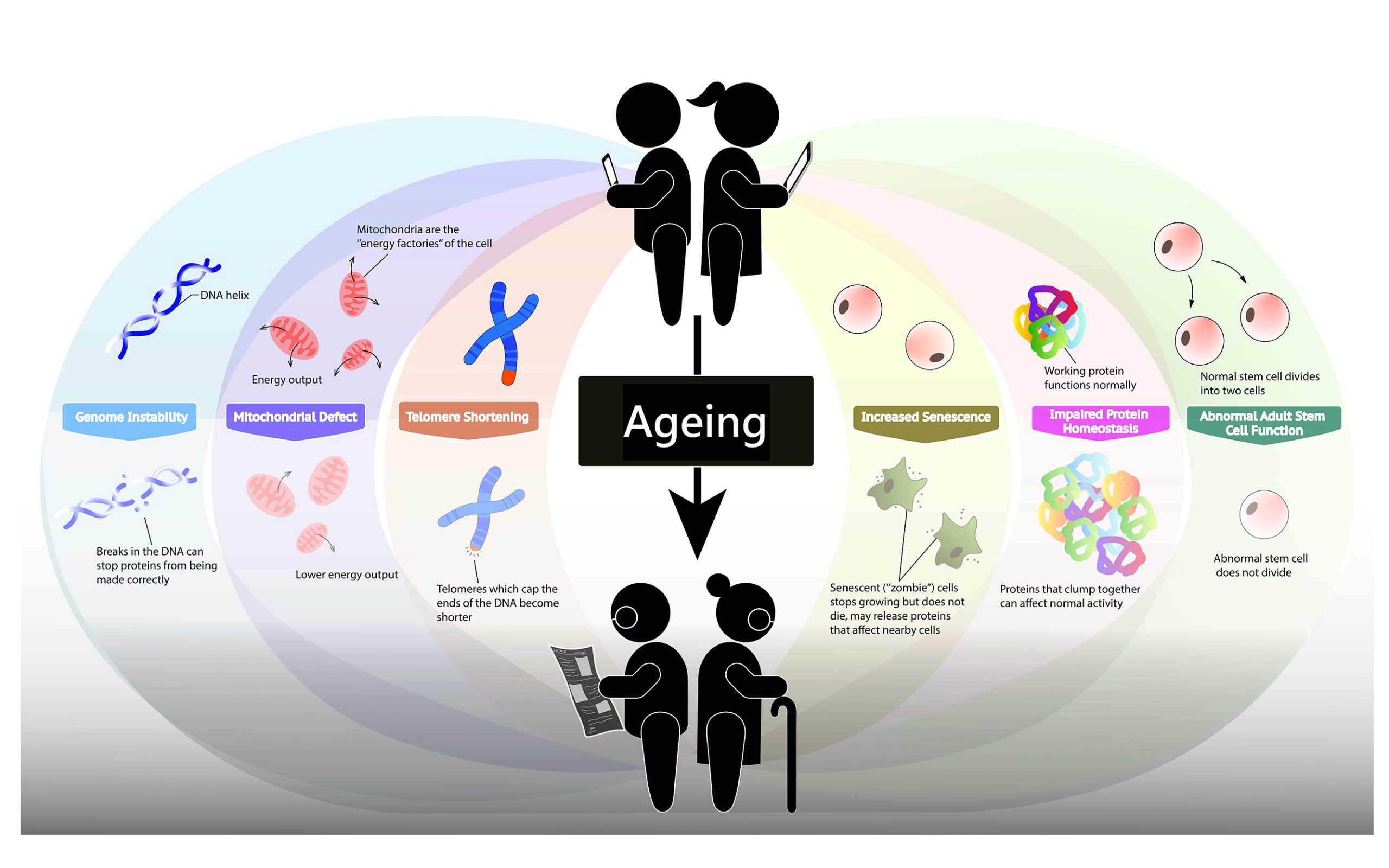


    The concept of ageing is a mysterious process and raises many questions. Why do organisms age? Why do we die at different ages? What are the mechanisms that underlie ageing? This is especially intriguing when scientists observe varying lifespans of one laboratory mice strain, consisting of genetically identical individuals. With ageing comes the prospect of increased cellular dysfunction, affecting normal tissue functions leading to the development of age-related diseases, such as cancer, neurodegenerative disorders, and cardiovascular diseases (CVD). The average life expectancy of humans has improved massively worldwide, partly due to better improvements in medical treatments, diagnosis, and the healthcare system. With humans living longer, this brings an increased burden on the healthcare system to take care of the elderly, who may be suffering age-associated deficits / problems, as well as the prospect of having an older working population, whose productivity may be lower. A common feature of the elderly is increased frailty and the development of dementia as they approach their eighties. Why is ageing associated with these deficits, and are there ways to circumvent these shortcomings and potentially live forever?

    Most of our current understanding of ageing has relied upon studies performed in animal and single-cell models, such as laboratory mice, the nematode worm, Caenorhabditis elegans (C.elegans), and the yeast Saccharomyces cerevisiae (S.cerevisiae). Despite the huge number of ageing studies, our understanding of ageing is limited since these models only simulate some aspects of ageing features. Hence, we are still unable to answer the questions posed above. I wish to direct the reader to the concepts of “chronological” versus “biological” ageing. The former refers to the amount of time passed from birth to a given date, while the latter occurs when the organism gradually accrues irreversible damage (to macromolecules, such as DNA, proteins, lipids) within their cells. Here we will discuss biological ageing, in terms of some of the ageing traits and what we might do to slow the effects of ageing to live a long and fruitful life.


    Author profile

    Prof Tom Cheung is currently the S H Ho Associate Professor of Life Science in the Division of Life Science at The Hong Kong University of Science and Technology (HKUST). He received his PhD in Biochemistry from the University of Colorado, United States of America. He specialises in the field of stem cells and the biology of ageing using murine muscle stem cells to identify the key molecular pathways that underlie stem cell quiescence and tissue regeneration. Prof Cheung is also a recipient of the Croucher Innovation Award in 2015 for the study of “Molecular regulation of stem cell ageing” and has published more than 30 scientific papers in high impact journals. Furthermore, Prof Cheung is Director of the HKUST-Nan Fung Life Sciences Joint Laboratory, Associate Director of the Biosciences Central Research Facility at HKUST, Director of the HKUST-BGI Joint Research Center, and Associate Director of the HKUST-Shanghai Sixth People’s Hospital Joint Research Center for Brain Science, as well as being a key member of the Hong Kong Center for Neurodegenerative Diseases (HKCeND) at the Hong Kong Science Park.

    Dr Erin Tse received her PhD in Biomedical Sciences from Aston University, United Kingdom, studying Alzheimer’s disease under the supervision of Dr Eric Hill. To further her personal growth, Erin moved to Hong Kong working in microbiology, followed by some time in a virology group using human stem-cell-derived enteroids to study the host interactome of human norovirus structural proteins. Through her experiences, she specialises in the study of cell biology. Currently, Dr Tse is a Postdoctoral Fellow in the Cheung Laboratory, where she continues to further stem cell research. Dr Tse is also an active member of the HKUST-Nan Fung Joint Sciences Laboratory, largely responsible for manageing the joint lab activities and mentorship of trainees.


  • newsletter (Mar 2022 – Issue 14)

    newsletter (Mar 2022 – Issue 14)


    關於香港桂冠論壇


    歡迎大家來到香港桂冠論壇2022年3月份通訊。

    在過去的一年,雖然在新冠病毒疫情的陰霾下令舉辦實體活動的難度有所增加,但我們很高興得到很多學術界、科學界和教育界等機構和人士的鼎力支持,先後成功舉行了多個與科學有關的項目和宣傳活動。當中包括首屆桂冠論壇前奏的主題活動「科學解密」、「智者‧智講」和「探索新視野」以及名為「與智者對談」的短片系列。大家可以到我們的網站、社交媒體平台和YouTube頻道觀看過去一年的精華片段、「與智者對談」短片系列以及一些與香港本地科學家訪問的片段。我們會繼續與各界人士聯繫,貫徹香港桂冠論壇的使命︰促進不同世代、文化和領域的科學家互相交流;支援香港和國際社會的青年發展;提升香港年輕一代對不同科技領域的認識和興趣;以及推動香港科學和科技各個領域的教育和交流。

    首屆香港桂冠論壇申請的首輪評審已於去年3月完成,而第二輪評審也於剛過去的2月成功舉行。科學評審大會在315位申請者中,揀選出229位參加首屆香港桂冠論壇。秘書處已經透過電郵通知各位申請者有關申請結果,也會陸續公佈有關首屆桂冠論壇的其他安排。

    每年的4月22日是世界地球日(Earth Day),這是一項展示對環境保護支持的世界性年度活動,目的是透過不同的方式宣傳和實踐環境保護的觀念。科學和數據證明氣候變化是確實存在的,最近十年是有記錄以來最暖的十年期。近幾年的暖化情況尤其明顯,世界氣候變化影響十分深遠,緩解氣候變化影響的工作刻不容緩。為響應世界地球日以及提升大家對氣候變化的認識和關注,香港桂冠論壇在早前拍攝了一系列與氣候變化有關的短片,這些短片將會在4月22日開始,在我們的網站和社交媒體平台陸續推出與大家分享。除了短片以外,我們亦會透過網站和通訊發佈一些與環境保護、氣候變化、科學數據或相關議題有關的文章,大家記得留意!


    諾貝爾物理學獎得獎者—高錕教授


    去年十一月,本刊第十二期通訊刊出時,適值華裔諾貝爾物理學獎得主楊振寧教授百歲生辰,香港中文大學(中大)特別舉辦了大型專題展覽。我們亦刊登了由中大物理系楊綱凱教授撰寫,名為《百年物理 – 賀楊振寧教授 – 百歳生辰》的文章,除介紹楊振寧教授的卓越學術成就外,亦講述了他與香港多年來所有建立的密切關係。

    其實,香港雖然是彈丸之地,卻是幾位獲諾貝爾物理學獎得獎者年青時居住及受教育的地方!

    今期,就讓我們介紹有「光纖之父」稱謂的諾貝爾物理學獎得獎者—高錕教授在工程和物理學上的卓越成就和對香港高等教育的重大貢獻。


    光纖之父

    高錕被譽為「光纖之父」、「光纖通訊之父」、「寬帶教父」及為2009諾貝爾物理學獎得獎者,說他是現代最重要和最有影響力的工程家之一,絕對是無容置疑的。他在「光傳輸於纖維的光學通信領域突破性成就(for groundbreaking achievements concerning the transmission of light in fibers for optical communication)」,更造就了互聯網時代的的爆炸性發展。


    暗物質


    如果您喜歡觀星,您可能看過壯麗的星系,並讚嘆這些由千億個恆星組成的雄偉結構(圖一)。太陽是我們的家鄉星系銀河系中的典型恆星,而銀河系亦是宇宙中的典型星系。星系組合成星系團,形成更大的結構(圖二)。星系內除了恆星,還有什麼物質?星系和星系團是如何形成的?這些結構是如何從早期宇宙中幾乎完全均勻的物質分佈中出現的?這些只是科學家想要解答的問題的一部份。事實證明,一種稱為暗物質的神秘物質在所有這些問題中都有著關鍵角色。

    在 1930 年代,天文學家茲威基(Zwicky)和 史密斯(Smith)測量后髮座星系團和室女座星系團的質量。他們的方法是這樣的:星系團的質量與其對星系的重力成正比,而星系繞着星系團運行的速度則與其感受的重力直接相關。經過仔細測量了星系的速度之後,茲威基和史密斯驚訝地發現,這兩個星系團的質量應該比可見物質(恆星和氣體)大得多。換句話說,星系團內一定有很多「暗物質」(”Dunkle Materie”)–不發光但衍生重力的物質。應用同樣的想法,維拉魯賓(Vera Rubin)測量了星系的旋轉曲線——恆星和氣體在離星系中心不同距離的軌道速度(圖 三)。她發現大多數星系的自轉曲線即使在距離中心很遠的地方也不會下降。這表明在幾乎沒有可見物質存在的星系外圍,重力仍然不會減弱,顯示星系中可見物質藏在一個大很多的暗物質暈(dark matter halo)中。例如,銀河系的暗物質暈至少延伸到其發光盤半徑的 4-5 倍,其質量是可見物質的 5-10 倍。


    作者:
    香港中文大學物理系朱明中教授


    老化 – 所有生命的必然結局?


    「老化」是個神秘的過程,而且引發了我們許多疑問。為何生物會老化?為何我們死亡的年齡又各有不同?老化背後又蘊藏著什麼機制?科學家觀察到,一組實驗室小鼠即使基因相同,每隻壽命卻各有不同,令人嘖嘖稱奇。當生物老化時,細胞功能失常的情況會增加,影響正常組織功能,導致與年齡相關的疾病形成,如癌症、神經退化性疾病、心血管疾病 (CVD)。全球人類平均預期壽命大幅提高,部分原因來自治療、診斷和醫療體系的進步。隨著人類壽命延長,對老年人的照顧亦加重了醫療體系的負擔,皆因老化會伴隨著很多與年齡相關的缺陷或問題;另外,勞動人口老化亦導致生產力降低的問題。老年人的共同特徵是越接近八十歲,衰弱會越變得明顯,以及容易罹患腦退化症。為何老化會離不開這些缺陷?人類有沒有辦法跨越這些缺陷,甚至邁向長生不老?

    我們目前對老化的大部分理解都來自對動物及單細胞模型所作過的研究,例如實驗室小鼠、線蟲(即秀麗隱桿線蟲,學名Caenorhabditis elegans,簡稱C.elegans)及酵母(即釀酒酵母,學名Saccharomyces cerevisiae,簡稱S.cerevisiae)。儘管已有大量對老化的研究,但我們對此的理解仍然有限,因為這些動物模型只模擬了老化某些方面的特徵,所以我們對上述問題仍然是無從入手。希望本文能引領讀者了解「時間上」的老化與「生物上」的老化概念有何不同︰前者是指由出生至某個日期所經過的時間長度;後者是指生物體的細胞逐漸累積不可逆轉的損傷(例如 DNA、蛋白質、脂質等大分子)。本文會從某些老化的特徵探討生物老化,以及我們可以透過什麼途徑減慢衰老,從而活出長壽而豐富的人生。


    作者簡介

    張曉東教授現為香港科技大學(HKUST)生命科學部的何善衡生命科學副教授。張教授在美國科羅拉多大學獲得生物化學博士學位。他的研究專長是幹細胞及老化生物學,曾利用實驗室老鼠的肌肉幹細胞發現幹細胞靜止及組織再生的關鍵分子路徑。張教授亦因「幹細胞衰老過程中的分子控制」研究獲得 2015 年裘槎前瞻科研大獎,並曾在著名期刊發表超過三十篇科學論文。此外,張教授亦擔任香港科技大學 – 南豐集團聯合實驗室主任、生物科學實驗中心副主任、香港科技大學-華大基因聯合研究中心主任、香港科技大學-上海第六人民醫院腦科學聯合研究中心副主任,以及位於香港科學園的香港神經退行性疾病中心 (HKCeND) 的主要成員。

    Erin Tse博士在英國阿斯頓大學獲得生物醫學科學博士學位,在 Eric Hill 博士的指導下研究阿茲海默症。謝博士為求有更高發展而移居香港,從事微生物學研究,隨後加入病毒學小組一段時間,利用由人類幹細胞衍生的類腸道組織研究人類諾沃克病毒結構蛋白的宿主互作。謝博士憑藉其學術經驗,專門從事細胞生物學的研究。謝博士目前是張教授實驗室的博士後研究員,並將在此繼續其幹細胞研究。謝博士亦是香港科技大學 – 南豐集團聯合實驗室的活躍成員,主要負責管理聯合實驗室的活動及指導學員。