Author: superadmin02

  • 新冠病毒多角度

    新冠病毒多角度

    新冠病毒疾病疫情继续影响着全球,不同国家/地区的研究团队一直努力不懈对抗疫情。我们在之前的通讯中都有分享过一些不同科学范畴在新冠病毒疾病中的角色和分析,包括2020年5月刊《香港理工大学团队对2019年冠状病毒的流行病学研究》、2020年9月刊梁秉中教授的《跨出疫曲的牵滞》以及上一期胡德超医生的《2019新冠病毒疾病的临床管理》…

    (more…)

  • Multi-facets of COVID-19

    Multi-facets of COVID-19

    The COVID-19 pandemic (the pandemic) continues to affect the world, research teams in different countries/places have been working relentlessly to combat the pandemic. Besides epidemiological study, vaccines development, and clinical management which are fields that are directly related to the combat of the pandemic, some areas of medicine where COVID-19 also has an important impact on patient care are being studied by Hong Kong medical teams…

    (more…)

  • newsletter (Jan 2021 – Issue 7)


    关于香港桂冠论坛

    欢迎大家来到香港桂冠论坛2021年1月份通讯。

    首届香港桂冠论坛(桂冠论坛)的申请已经在2020年12月13日截止。我们一共收到超过450份来自全球超过30个不同国家/地区包括澳洲、英国、中国、俄罗斯、新加坡及南韩等人士申请参加首届桂冠论坛,令人鼓舞的是申请者当中,男女比例差不多各佔一半。这些申请在接下来的两个月会由一组两级制的国际专业科学总评审团负责甄选,选出200名青年科学家参加首届桂冠论坛。有关2021桂冠论坛科学总评审团的资料,可到我们的网站查阅。

    除了公开申请之外,香港桂冠论坛亦为本地大学本科生设计了一个为期两日,名为”Tomorrow’s Scientists Exploration Camp”的活动,作为甄选香港青年科学家参加桂冠论坛的渠道。这个活动已经在2021年1月5及16日顺利以线上形式举行,一共有超过60位由他们所属的香港大专院校提名的学生参加。我们十分荣幸邀请到一些香港的学者担任是次活动的嘉宾讲者和评审,分别是:


    • 香港科技大学生命科学部副教授张晓东教授、

    • 香港浸会大学数学系助理教授韩汝星博士、

    • 香港中文大学物理系副教授李华白教授、

    • 香港城市大学数学系助理教授罗永昌博士、

    • 香港大学病理学系助理教授黄泽蕾博士及

    • 香港城市大学物理系助理教授余咏芝博士


    在第一日的活动当中,韩博士和黄博士担任嘉宾与各位学生分享他们追求科学成就路上的经验,令学生们获益良多。


    韩汝星博士︰「做研究一定会有挫折,但遇上挫折时一定不要放弃。」


    黄泽蕾博士︰「作为科学家就像婚姻,对科学有一种责任和传承。」


    而第二日的活动中,学生有机会向各位参予评审的教授和其他学生分享自己研究的项目,藉此可以激發更多有关科学的构思。同时,他们亦为以他们组别身份参予桂冠论坛竞夺席位。


    另外,2020年度创新科技嘉年华亦于2020年12月23日至31日以线上形式举行,桂冠论坛亦有参展。我们的线上摊位除了介绍了有关桂冠论坛的资料外,更首播了两段香港中文大学医学院卢煜明教授分享追求科学旅程的短片,如果大家错过了,可即时到我们的网站观赏,已看过的也可以重温!


    「牛年将至,桂冠论坛预祝各位新年快乐、身体健康、丰盛年年!」


    相场模型及其高效数值方法

    相场方法的思想来源可以追溯到Lord Rayleigh、Josiah Willard Gibbs 和 Van der Waals的研究。从那时起,它就成为了一种模拟和预测介观尺度形态和微观结构演变现象的强有力方法。这些现象在许多领域中都会产生,如生物学、材料科学、图像处理、多相流体力学、化学和石油工程等。科学家们设计出各种各样的相场模型,用于描述相分离和相变的过程。一般地,相场模型在每个相中取不同的数值(例如图1中的+1和-1),在界面周围有限宽度的薄层中,相值之间的变化是平滑的。


    ( 圖1:相场函数 )

    能量泛函在相场方法中起着至关重要的作用。在相场方法中,相分离与相变过程是能量驱动的,其动力学系统可以看作是某个Helmholtz能量泛函的梯度流。Helmholtz自由能泛函可以写为界面能量和相内自由能两部分能量之和。界面自由能是指储存在界面层的能量,可以通过相函数 (图1中的 ϕ)来定义。正如预期的那样,它依赖于界面层的宽度(图1中的 ε)。另一方面,相内自由能通常是问题相关的,可能包括其他几种类型的能量,如动能和势能/梯度能。能量泛函的引入使得相场建模变得系统化。在实际应用中,相场建模的主要任务是建立Helmholtz自由能泛函和提供能量耗散机制的驱动力。


    新冠病毒多角度

    新冠病毒疾病疫情继续影响着全球,不同国家/地区的研究团队一直努力不懈对抗疫情。我们在之前的通讯中都有分享过一些不同科学范畴在新冠病毒疾病中的角色和分析,包括2020年5月刊《香港理工大学团队对2019年冠状病毒的流行病学研究》、2020年9月刊梁秉中教授的《跨出疫苗的牵滞》以及上一期胡德超医生的《2019新冠病毒疾病的临床管理》。除了病学研究、研發疫苗以及临床管理等这些比较直接与疫情有关的范畴外,香港医疗团队正在研究新冠病毒疾病对患者护理也有重要影响的医学领域。在这一期通讯中,我们有香港中文大学医学院的黄永坚教授和莫仲棠教授的两个有关的研究。

    从数据上發现儿童感染新冠病毒疾病的机会较小,而即使感染后發病的机会也是较小。儿科学系教授黄永坚教授带领第一个研究团队研究新冠病毒疾病如何影响被感染的儿童。

    黄教授带领的团队The Chinese Paediatric Novel Coronavirus study team研究了疫情初期受感染儿童的流行病学特性、临床特徵和放射学發现。

    儿童及少年感染新冠病毒疾病案例的流行病学研究,有助更深入了解SARS-CoV-2病毒的潜在免疫反应及其严重性。与成人患者相反,大多数受感染儿童的一般临床病徵例如咳嗽、疲劳、肌肉疼痛、呕吐和肚泻都较轻。只有一半受感染儿童有發烧的病徵。按此阅读黄教授在The England Journal of Medicine的發表以了解更多。

    另一方面,认知障碍症患者也特别容易受到SARS-CoV-2病毒的感染。他们不单止有高风险可能感染新冠病毒疾病,更会在实施针对疫情的对策时,因为未能保持适当社交距离或隔离措施而受到伤害。

    内科及药物治疗学系脑神经科主任莫仲棠教授带领一个国际团队,为老年人及认知障碍症患者制定策略,令他们在疫情期间能够得到适当的治疗。团队提倡措施,例如使用线上谘询和远程医疗建议等远程治疗方法以确保提供护理服务。其他措施率先用于认知障碍症患者的群体居住设施,在一般情况下也可用于老年人的护理。

    该团队云集了来自全球16个国家29所大专院校,包括牛津大学、剑桥大学、阿姆斯特丹自由大学、哈佛大学和卡罗琳医学院。按此阅读团队在Alzheimer’s & Dementia的發表以了解更多。


    鸣谢:香港中文大学医学院


    改变世界的科研力量

    全球化是世界發展的大趋势。随着互联网普及,通讯科技發展一日千里,促进了知识传播和思想交流。知識全球化,科学研究也迈向全球化。从基础科学研究到前沿技术發展,都有跨地域、跨领域协作的趋势。细数近二十年的国际科学大奬,例如诺贝尔奖,和被誉为「东方诺贝尔奖」的邵逸夫奖,有不少都是由跨国科学家和研究团队夺得的。

    其中一个例子是2020年诺贝尔化学奖,就由法国女科学家沙尔庞捷教授和美国女科学家杜德纳教授共同夺得。二人在2012年發表了名为「CRISPR / Cas9」的基因剪刀技术,为基因编辑科技带来重大突破。此技术已被应用于农作物和家畜上,并有望为治疗癌症和其他遗传病作出贡献。杜德纳教授于2017年获香港大学颁授名誉科学博士,并出席了港大医学院的学位颁授典礼,两代科学人共济一堂,传承了科学和研究的精神。

    不得不提的是有「科学界奥斯卡」之称的科学突破奖,其2020年度的基础物理奖就是颁發给拍得人类史上首张黑洞相片的EHT团队。EHT团队是由全球超过300名科学家合作,把各地的天文望远镜连接,组合成一座超巨型、口径相当于地球直径的无线电望远镜网络。这些望远镜分别位于美国、墨西哥、智利、法国、格陵兰岛和南极。无线电望远镜并非直接拍出黑洞的影像,而是提供了许多科学数据,必须经过複杂的运算和调校,再由科学家们建构出黑洞的影像。EHT成员之一、来自香港的天文学家陈志均指出,云端运算对今次的国际合作非常重要,能跨地域为全球其他科学家提供庞大数据。

    由此可见,科学界渴求的生力军,除了要对科学好奇、具备坚毅的研究精神,还要有创新思维、国际视野,和团队协作的综合能力。

    回顾科学發展里程,不少具前瞻性的發明和發现,在萌芽阶段时,或许只是一些看似天马行空、遥不可及的想法,但经过科学家和研究团队的不懈探索研究琢磨,假以时日也会得到实现,甚至改变人类的未来。正如数学物理学家马克士威在 1865 年,从理论演算中预测了电磁波的存在,当时亦曾被其他科学家质疑。没想到百年后的今天,从手机的无线网路和电子钱包,以至天上的天气雷达和太空的气象卫星,到处都有使用到电磁波了,对人类文明、科技和生活质素产生重大贡献。

    今天的科学梦,可能就是明日的伟大發明。有志成为科学领袖的年青人,可透过参加桂冠论坛的良机,与世界顶尖科学大师接触和交流,培养前瞻思维,扩阔国际视野,建立人脉网络,并与科学和科研志趣相投的持份者有效沟通,这些经验对于提升研究实力、改良技术、寻找资源,以至促进跨文化、跨领域的协作,定会带来帮助。


    大合相

    在天文学裡,合相是指从一个特定天体(例如地球)观察到两个天体在天空上的位置非常靠近。合相發生的时候这两个被观察的天体的位置有相同的赤经或黄经。而「大合相」就是指木星和土星的合相,被冠名为「大」是因为木星合土星是至今最罕见的由地球上可见行星的合相。2020年12月,香港的上空便出现了一次罕见的大合相,这次大合相从地球看上天空中的木星和土星的距离十分接近,只有6.1角分,而上一次两颗星体距离少于10角分的大合相已经要追溯至1623年。


    大合相,尤其是2020年的这一次有多罕见?


    木星的公转周期约为11.9年,而土星公转周期约为29.5年,这形成了它们之间一个五比二的共振周期,即是木星要环绕太阳公转五次,土星才会公转两次。在地球上看,大合相每二十年才会出现一次,相比其他行星的合相更为罕见。例如,水星和金星的合相大约1.6年便会出现一次,木星和火星的合相大约2.2年出现一次。2020年的大合相吸引了不少天文爱好者观赏,除了两天体的距离十分近之外,更因为大家用肉眼便已经可以看得到。因两颗行星的轨道不同,在每次合相时,它们之间的距离都不一样,比较接近的合相要六十年一遇,两颗星体再接近一点的合相更是四百年一遇。而合相的能见度亦会受到季节、天气及合相出现的纬度所影响,对上一次能够用肉眼观赏到而星体距离这麽接近的大合相是在1226年,在过去八百年间还有两次分别是1563年和1623年距离少于10角分的大合相,但是因为这两次的大合相方向太接近太阳而难以被观赏得到。 下一次星体距离这麽近的大合相要等到2080年才会再出现。


    大合相与伯利恆之星


    古时候,人们都会从天象变化中预测未来,认为天空有异象时是对人们的预示。《新约圣经》的《马太福音》中曾提及,耶稣降生时天空上有一颗十分明亮的星体,照亮了整个伯利恆。东方三博士就奉命跟随着这颗星体,到伯利恆寻找耶稣。这颗明亮的星体就是「伯利恆之星」。自古以来,不少天文学家及爱好者都致力寻找「伯利恆之星」的真正身份,更提出了不同的假说证明「伯利恆之星」是现实存在。

    在十七世纪初,着名的德国天文学家约翰尼斯·克卜勒先生發表行星运动定律,并提出「伯利恆之星」可能就是在公元前七年出现的土木大合相。在公元前七年先后發生了三次土木合相,分别位于5月下旬,9月下旬及12月上旬。这个说法虽然其后被推翻,但启發人们提出了「伯利恆之星」可能是个天文现象的想法。另外,天文学家欧内斯特·马丁先生及克雷格·切斯特先生从天文软件计算中,认为「伯利恆之星」就是在公元前三年时發生的木星和土星的近合,因为两颗星体当时的距离十分相近,所以被认为是一个明亮的星体。


    然而,因为目前仍没有耶稣准确出生日期的历史记载,所以以上假说亦没法被证明是否属实。或许寄望将来科学更进步时,为我们掀开这颗星的神秘面纱。


  • newsletter (Jan 2021 – Issue 7)


    關於香港桂冠論壇

    歡迎大家來到香港桂冠論壇2021年1月份通訊。

    首屆香港桂冠論壇(桂冠論壇)的申請已經在2020年12月13日截止。我們一共收到超過450份來自全球超過30個不同國家/地區包括澳洲、英國、中國、俄羅斯、新加坡及南韓等人士申請參加首屆桂冠論壇,令人鼓舞的是申請者當中,男女比例差不多各佔一半。這些申請在接下來的兩個月會由一組兩級制的國際專業科學總評審團負責甄選,選出200名青年科學家參加首屆桂冠論壇。有關2021桂冠論壇科學總評審團的資料,可到我們的網站查閱。

    除了公開申請之外,香港桂冠論壇亦為本地大學本科生設計了一個為期兩日,名為”Tomorrow’s Scientists Exploration Camp”的活動,作為甄選香港青年科學家參加桂冠論壇的渠道。這個活動已經在2021年1月5及16日順利以線上形式舉行,一共有超過60位由他們所屬的香港大專院校提名的學生參加。我們十分榮幸邀請到一些香港的學者擔任是次活動的嘉賓講者和評審,分別是:


    • 香港科技大學生命科學部副教授張曉東教授、

    • 香港浸會大學數學系助理教授韓汝星博士、

    • 香港中文大學物理系副教授李華白教授、

    • 香港城市大學數學系助理教授羅永昌博士、

    • 香港大學病理學系助理教授黃澤蕾博士及

    • 香港城市大學物理系助理教授余詠芝博士

    在第一日的活動當中,韓博士和黃博士擔任嘉賓講者與各位學生分享他們追求科學成就路上的經驗,令學生們獲益良多。


    韓汝星博士︰「做研究一定會有挫折,但遇上挫折時一定不要放棄。」


    黃澤蕾博士︰「作為科學家就像婚姻,對科學有一種責任和傳承。」


    而第二日的活動中,學生有機會向各位參予評審的教授和其他學生分享自己研究的項目,藉此可以激發更多有關科學的構思。同時,他們亦以他們組別身份參予桂冠論壇競奪席位。


    另外,2020年度創新科技嘉年華亦於2020年12月23日至31日以線上形式舉行,桂冠論壇亦有參展。我們的線上攤位除了介紹了有關桂冠論壇的資料外,更首播了兩段香港中文大學醫學院盧煜明教授分享追求科學旅程的短片,如果大家錯過了,可即時到我們的網站觀賞,已看過的也可以重溫!


    「牛年將至,桂冠論壇預祝各位新年快樂、身體健康、豐盛年年!」


    相場模型及其高效數值方法

    相場方法的思想來源可以追溯到Lord Rayleigh、Josiah Willard Gibbs 和 Van der Waals的研究。從那時起,它就成為了一種模擬和預測介觀尺度形態和微觀結構演變現象的強有力方法。這些現象在許多領域中都會產生,如生物學、材料科學、圖像處理、多相流體力學、化學和石油工程等。科學家們設計出各種各樣的相場模型,用於描述相分離和相變的過程。一般地,相場模型在每個相中取不同的數值(例如圖1中的+1和-1),在界面周圍有限寬度的薄層中,相值之間的變化是平滑的。


    ( 圖1:相場函數 )

    能量泛函在相場方法中起著至關重要的作用。在相場方法中,相分離與相變過程是能量驅動的,其動力學系統可以看作是某個Helmholtz能量泛函的梯度流。Helmholtz自由能泛函可以寫為界面能量和相內自由能兩部分能量之和。界面自由能是指儲存在界面層的能量,可以通過相函數(圖1中的ϕ)來定義。正如預期的那樣,它依賴於界面層的寬度(圖1中的ϕ)。另一方面,相內自由能通常是問題相關的,可能包括其他幾種類型的能量,如動能和勢能/梯度能。能量泛函的引入使得相場建模變得系統化。在實際應用中,相場建模的主要任務是建立Helmholtz自由能泛函和提供能量耗散機制的驅動力。


    新冠病毒多角度

    新冠病毒疾病疫情繼續影響著全球,不同國家/地區的研究團隊一直努力不懈對抗疫情。我們在之前的通訊中都有分享過一些不同科學範疇在新冠病毒疾病中的角色和分析,
    包括2020年5月刊《香港理工大學團隊對2019年冠狀病毒的流行病學研究》、2020年9月刊梁秉中教授的《跨出疫苗的牽滯》以及上一期胡德超醫生的《2019新冠病毒疾病的臨床管理》。除了病學研究、研發疫苗以及臨床管理等這些比較直接與疫情有關的範疇外,香港醫療團隊正在研究新冠病毒疾病對患者護理也有重要影響的醫學領域。在這一期通訊中,我們有香港中文大學醫學院的黃永堅教授和莫仲棠教授的兩個有關的研究。

    從數據上發現兒童感染新冠病毒疾病的機會較小,而即使感染後發病的機會也是較小。兒科學系教授黃永堅教授帶領第一個研究團隊研究新冠病毒疾病如何影響被感染的兒童。

    黃教授帶領的團隊The Chinese Paediatric Novel Coronavirus study team研究了疫情初期受感染兒童的流行病學特性、臨床特徵和放射學發現。

    兒童及少年感染新冠病毒疾病案例的流行病學研究。有助更深入了解SARS-CoV-2病毒的潛在免疫反應及其嚴重性。與成人患者相反,大多數受感染兒童的一般臨床病徵例如咳嗽、疲勞、肌肉疼痛、嘔吐和肚瀉都較輕。只有一半受感染兒童有發燒的病徵。按此閱讀黃教授在The England Journal of Medicine的發表以了解更多。

    另一方面,認知障礙症患者也特別容易受到SARS-CoV-2病毒的感染。他們不單止有高風險可能感染新冠病毒疾病,更會在實施針對疫情的對策時,因為未能保持適當社交距離或隔離措施而受到傷害。

    內科及藥物治療學系腦神經科主任莫仲棠教授帶領一個國際團隊,為老年人及認知障礙症患者制定策略,令他們在疫情期間能夠得到適當的治療。團隊提倡措施,例如使用線上諮詢和遠程醫療建議等遠程治療方法以確保提供護理服務。其他措施率先用於認知障礙症患者的群體居住設施,在一般情況下也可用於老年人的護理。

    該團隊雲集了來自全球16個國家29所大專院校,包括牛津大學、劍橋大學、阿姆斯特丹自由大學、哈佛大學和卡羅琳醫學院。
    按此閱讀團隊在Alzheimer’s & Dementia的發表以了解更多。


    鳴謝:香港中文大學醫學院


    改變世界的科研力量

    全球化是世界發展的大趨勢。隨著互聯網普及,通訊科技發展一日千里,促進了知識傳播和思想交流。知識全球化,科學研究也邁向全球化。從基礎科學研究到前沿技術發展,都有跨地域、跨領域協作的趨勢。細數近二十年的國際科學大奬,例如諾貝爾獎,和被譽為「東方諾貝爾獎」的邵逸夫獎,有不少都是由跨國科學家和研究團隊奪得的。

    其中一個例子是2020年諾貝爾化學獎,就由法國女科學家沙爾龐捷教授和美國女科學家杜德納教授共同奪得。二人在2012年發表了名為「CRISPR / Cas9」的基因剪刀技術,為基因編輯科技帶來重大突破。此技術已被應用於農作物和家畜上,並有望為治療癌症和其他遺傳病作出貢獻。杜德納教授於2017年獲香港大學頒授名譽科學博士,並出席了港大醫學院的學位頒授典禮,兩代科學人共濟一堂,傳承了科學和研究的精神。

    不得不提的是有「科學界奧斯卡」之稱的科學突破獎,其2020年度的基礎物理獎就是頒發給拍得人類史上首張黑洞相片的EHT團隊。EHT團隊是由全球超過300名科學家合作,把各地的天文望遠鏡連接,組合成一座超巨型、口徑相當於地球直徑的無線電望遠鏡網絡。這些望遠鏡分別位於美國、墨西哥、智利、法國、格陵蘭島和南極。無線電望遠鏡並非直接拍出黑洞的影像,而是提供了許多科學數據,必須經過複雜的運算和調校,再由科學家們建構出黑洞的影像。EHT成員之一、來自香港的天文學家陳志均指出,雲端運算對今次的國際合作非常重要,能跨地域為全球其他科學家提供龐大數據。

    由此可見,科學界渴求的生力軍,除了要對科學好奇、具備堅毅的研究精神,還要有創新思維、國際視野,和團隊協作的綜合能力。

    回顧科學發展里程,不少具前瞻性的發明和發現,在萌芽階段時,或許只是一些看似天馬行空、遙不可及的想法,但經過科學家和研究團隊的不懈探索研究琢磨,假以時日也會得到實現,甚至改變人類的未來。正如數學物理學家馬克士威在 1865 年,從理論演算中預測了電磁波的存在,當時亦曾被其他科學家質疑。沒想到百年後的今天,從手機的無線網路和電子錢包,以至天上的天氣雷達和太空的氣象衛星,到處都有使用到電磁波了,對人類文明、科技和生活質素產生重大貢獻。

    今天的科學夢,可能就是明日的偉大發明。有志成為科學領袖的年青人,可透過參加桂冠論壇的良機,與世界頂尖科學大師接觸和交流,培養前瞻思維,擴闊國際視野,建立人脈網絡,並與科學和科研志趣相投的持份者有效溝通,這些經驗對於提升研究實力、改良技術、尋找資源,以至促進跨文化、跨領域的協作,定會帶來幫助。


    大合相

    在天文學裡,合相是指從一個特定天體(例如地球)觀察到兩個天體在天空上的位置非常靠近。合相發生的時候這兩個被觀察的天體的位置有相同的赤經或黃經。而「大合相」就是指木星和土星的合相,
    被冠名為「大」是因為木星合土星是至今最罕見的由地球上可見行星的合相。2020年12月,香港的上空便出現了一次罕見的大合相,這次大合相從地球看上天空中的木星和土星的距離十分接近,只有6.1角分,而上一次兩顆星體距離少於10角分的大合相已經要追溯至1623年。

    大合相,尤其是2020年的這一次有多罕見?


    木星的公轉周期約為11.9年,而土星公轉周期約為29.5年,這形成了它們之間一個五比二的共振周期,即是木星要環繞太陽公轉五次,土星才會公轉兩次。
    在地球上看,大合相每二十年才會出現一次,相比其他行星的合相更為罕見。例如,水星和金星的合相大約1.6年便會出現一次,木星和火星的合相大約2.2年出現一次。
    2020年的大合相吸引了不少天文愛好者觀賞,除了兩天體的距離十分近之外,更因為大家用肉眼便已經可以看得到。因兩顆行星的軌道不同,在每次合相時,它們之間的距離都不一樣,比較接近的合相要六十年一遇,
    兩顆星體再接近一點的合相更是四百年一遇。而合相的能見度亦會受到季節、天氣及合相出現的緯度所影響,對上一次能夠用肉眼觀賞到而星體距離這麼接近的大合相是在1226年,
    在過去八百年間還有兩次分別是1563年和1623年距離少於10角分的大合相,但是因為這兩次的大合相方向太接近太陽而難以被觀賞得到。 下一次星體距離這麼近的大合相要等到2080年才會再出現。

    大合相與伯利恆之星


    古時候,人們都會從天象變化中預測未來,認為天空有異象時是對人們的預示。《新約聖經》的《馬太福音》中曾提及,耶穌降生時天空上有一顆十分明亮的星體,照亮了整個伯利恆。東方三博士就奉命跟隨著這顆星體,到伯利恆尋找耶穌。這顆明亮的星體就是「伯利恆之星」。自古以來,不少天文學家及愛好者都致力尋找「伯利恆之星」的真正身份,更提出了不同的假說證明「伯利恆之星」是現實存在。

    在十七世紀初,著名的德國天文學家約翰尼斯·克卜勒先生發表行星運動定律,並提出「伯利恆之星」可能就是在公元前七年出現的土木大合相。在公元前七年先後發生了三次土木合相,分別位於5月下旬,9月下旬及12月上旬。這個說法雖然其後被推翻,但啟發人們提出了「伯利恆之星」可能是個天文現象的想法。另外,天文學家歐內斯特·馬丁先生及克雷格·切斯特先生從天文軟件計算中,認為「伯利恆之星」就是在公元前三年時發生的木星和土星的近合,因為兩顆星體當時的距離十分相近,所以被認為是一個明亮的星體。

    然而,因為目前仍沒有耶穌準確出生日期的歷史記載,所以以上假說亦沒法被證明是否屬實。或許寄望將來科學更進步時,為我們掀開這顆星的神秘面紗。


  • newsletter (Jan 2021 – Issue 7)


    About the Hong Kong Laureate Forum

    Welcome to the January 2021 issue of the newsletter of the Hong Kong Laureate Forum!

    Application for the inaugural Hong Kong Laureate Forum (the Forum) ended on 13 December 2020. We have received over 450 applications from more than 30 countries / places including Australia, Britain, China, Russia, Singapore, and South Korea etc. to join the Forum.
    We are encouraged to see almost equal split of male / female applicants. The applications will be reviewed by a two-tier Scientific Review Panel comprising both local and non-local academics, the panel will then select the final 200 young scientists to join the inaugural Forum. More information about the Scientific Review Panel of 2021 Forum is available on our website.

    Besides open application, the Council of the Hong Kong Laureate Forum (HKLF) also held a two-day event called “Tomorrow’s Scientists Exploration Camp” for local university undergraduates as a channel to select local young scientists to join the Forum. The event was successfully held online on 5 and 16 January 2021 with more than 60 students nominated by their universities in Hong Kong joining it. We are honoured to have academics from Hong Kong to be our guest speakers and panelists, namely:

    • Prof Tom Cheung, Associate Professor of Division of Life Science of The Hong Kong University of Science and Technology,
    • Dr Sean Hon, Assistant Professor of Department of Mathematics of Hong Kong Baptist University,
    • Prof Hua-bai Li, Associate Professor of Department of Physics of The Chinese University of Hong Kong,
    • Dr Wing-cheong Lo, Assistant Professor of Department of Mathematics of City University of Hong Kong,
    • Dr Carmen Wong, Assistant Professor of Department of Pathology of the University of Hong Kong and
    • Dr Wing-chi Yu, Assistant Professor of Department of Physics of City University of Hong Kong

    On the 1st day of the event, we had Dr Hon and Dr Wong as our guest speakers and they shared their journeys in pursuit of science with the students, this gave invaluable insights to students.


    “You always encounter setbacks when doing research, but never give up when that happens.” Dr Sean Hon


    “Being a scientist is like being married, one has both responsibility and obligation on the sharing of knowledge for science.” Dr Carmen Wong


    On the 2nd day of the event, students had opportunities to share their research projects with professors and fellow students so as to stimulate more scientific ideas. They were also vying for the final places for their category.


    Virtual InnoCarnival 2020 was also held online from 23-31 December 2020 and the HKLF participated in it. Our virtual booth not only covered information about the Forum but also premiered two videos about the journey in pursuit of science of Prof Dennis Yuk Ming Lo of the Faculty of Medicine, The Chinese University of Hong Kong. If you had missed the event, don’t worry, you may visit our website to watch the videos now! If you have watched it already, you are welcome to review them again.


    The Year of Ox is approaching, we would like to wish you a healthy, prosperous, and happy Chinese New Year!


    Phase Field Models and Their Effective Numerical Methods

    The idea of the phase field method could be traced back to Lord Rayleigh, Josiah Willard Gibbs, and Van der Waals. Since then, it has emerged as a powerful approach for modeling and predicting mesoscale morphological and microstructural evolution arising from many fields, such as biology, material sciences, image processing, multiphase fluid mechanics, chemical and petroleum engineering, etc. A variety of phase field models have been derived to describe phase separations and transitions. In general, phase field models take distinct values (for instance, +1 and -1 in Figure 1) in each of the phases, with a smooth change between phase values in a thin layer of finite width around the interface.
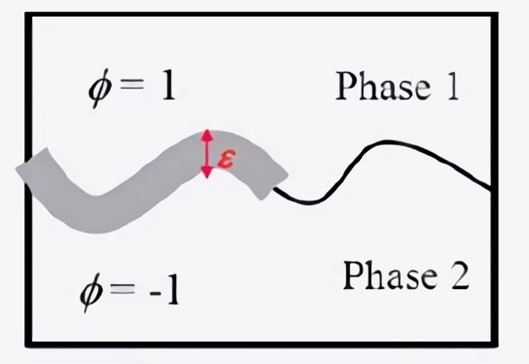


    ( Figure 1. Phase field function )

    Energy functionals play an important role in the phase field method. In the phase field approach, phase separations and transition processes are energy driven in the sense that the dynamics are the gradient
    flow of a certain Helmholtz energy functional. The Helmholtz free energy functional can be written as the sum of two parts: the interfacial energy and the bulk energy.
    The interfacial energy measures the energy stored in the interfacial layer and can be defined with the help of the phase function (ϕ in Figure 1). As expected, it would depend on the width of the interfacial layer (ϕ in Figure 1).
    On the other hand, bulk energy is usually problem dependent and may consist of several other types of energies such as kinetic and potential / gradient energy. This energetic approach makes the phase field modeling become systematic.

    In practice, the main task of the phase field modeling is the construction of the Helmholtz free energy functional and the driving forces that provide the mechanism of energy dissipation.


    Multi-facets of COVID-19

    The COVID-19 pandemic (the pandemic) continues to affect the world, research teams in different countries / places have been working relentlessly to combat the pandemic.
    In the previous issues of our newsletters, we shared articles on the roles of and also analysis by different scientific fields, such as “Epidemiological Study on Coronavirus 2019 at The Hong Kong Polytechnic University” in the May 2020 issue, “Beyond Vaccines” by Prof Ping-Chung Leung in the September 2020 issue and “Clinical Management of Coronavirus Disease 2019” by Dr Wu Tak Chiu in the last issue. Besides epidemiological study, vaccines development, and clinical management which are fields that are directly related to the combat of the pandemic, some areas of medicine where COVID-19 also has an important impact on patient care are being studied by Hong Kong medical teams. In the current issue, we have two articles by Prof Gary Wong and Prof Vincent Mok, both of the Faculty of Medicine of The Chinese University of Hong Kong on this aspect.

    Having noted that children have been less likely to contract COVID-19, and less likely to get sick when they do, Prof Gary Wong of the Department of Paediatrics headed the first study team to examine how the disease was affecting infected children.

    The Chinese Paediatric Novel Coronavirus study team led by Prof Wong looked at the epidemiologic characteristics, clinical features, and radiologic findings of infected children at the early stages of the pandemic.

    The epidemiology of juvenile cases of COVID-19 helped deliver insights into the underlying immune response to the SARS-CoV-2 virus and its severity. In contrast with adults, most infected children have a milder clinical course typified by cough, fatigue, muscle pain, vomiting, and diarrhea. Fever is only found in about half of the infected children. Check out Prof Wong’s publication in The New England Journal of Medicine here to learn more.

    On another aspect, people with dementia are particularly vulnerable to infection from SARS-CoV-2. Not only are they directly at high risk of contracting COVID-19, they are also hurt by the physical distancing necessary and isolation often created when implementing countermeasures against this infectious disease.

    Prof Vincent Mok, Head of Division of Neurology in the Department of Medicine and Therapeutics led an international team to devise strategies for the elderly and patients with dementia so that they can receive appropriate treatment during the pandemic. The team advocates measures such as the use of telemedicine to ensure delivery of care, with online consultations and remote medical advice. Other measures applied first and foremost to group-living facilities for people with dementia, but could in many cases be applied to the care of older people in general.

    The team brought together experts from 29 universities in 16 countries around the world, including the University of Oxford, the University of Cambridge, the Vrije University of Amsterdam, Harvard University, and the Karolinska Institute. Check out the team’s publication and recommendations in Alzheimer’s & Dementia here to learn more.


    Acknowledgment: Faculty of Medicine, The Chinese University of Hong Kong


    The World-changing Power of Scientific Research

    Globalisation is a major trend in world development. With the popularisation of the Internet,
    communication technology has developed rapidly and encouraged spread of knowledge and exchange of ideas. Knowledge and scientific research are also going globalised.
    From basic scientific research to the development of innovative technology, there are rapid proliferation of cross-region and cross-discipline collaboration.
    If we look at the major international awards on science subjects in the past two decades, such as the Nobel Prize and the Shaw Prize which is also known as the “Nobel of the East”,
    many prizes were awarded to research teams comprising multinational scientists as well as teams from different parts of the world working together.

    A case in point is the Nobel Prize in Chemistry in 2020, it was awarded to two female scientists, Prof Emmanuelle Charpentier of France and Prof Jennifer Doudna of the USA.
    They jointly published a gene scissors technology called “CRISPR / Cas9” in 2012, which was a major breakthrough in gene editing technology.
    This technology has been applied to crops and livestock and is expected to be conducive to the treatment of cancer and other genetic diseases.
    Prof Doudna was awarded Doctor of Science honoris causa by the University of Hong Kong in 2017 and she attended the Congregation Ceremony in Hong Kong, when two generations of scientists came together to inherit the spirit of science and research.

    Let’s also not forget the Breakthrough Prize, also known as the “Oscars of Science”,
    in Fundamental Physics 2020 was awarded to the Event Horizon Telescope Collaboration (the EHT) for establishing the first image of a supermassive black hole, which
    was taken by an Earth-sized alliance of telescopes. The EHT is a collaboration of more than 300 scientists around the world, connecting telescopes from different locations to
    form a giant radio telescope network with an aperture equivalent to the diameter of the Earth. These telescopes are located in the USA, Mexico, Chile, France, Greenland and Antarctica.
    The radio telescope does not only capture images of black hole directly but also provide a lot of scientific data, which scientists can construct images of black holes after complex calculations
    and calibrations. Mr Chan Chi-kwan, an astronomer from Hong Kong who is a member of the EHT pointed out that cloud computing is very important for this international collaboration and it
    can provide enormous data to other scientists from around the world.

    Thus, it demonstrates that, in addition to curiosity and perseverance in scientific pursuit, the new generation of scientists should also have innovative thinking, international perspective and ability to work in teams.

    Looking back at the milestones of scientific development, many trailblazing inventions and discoveries may just be pie in the sky at the early stage. However, after
    persistent work by scientists and research teams, they were realised and used to shape the future of mankind. For instance, when Mr James Maxwell, a mathematical physicist, predicted
    the existence of electromagnetic waves from theoretical calculations in 1865, other scientists cast serious doubt. A hundred years later, electromagnetic waves are widely used in many areas from mobile phone’s wireless networks and e-wallets to weather radars in the sky and satellites in space, making significant contributions to human civilisation, technology development and quality of life.

    What seems to be scientific dreams today may become great discoveries tomorrow. Young generation who aspires to become leader in scientific pursuits are encouraged to participate in
    Laureate Forums to interact and exchange views with world-renowned scientists, so as to cultivate innovative thinking,
    broaden international perspective, develop supportive network and communicate with different stakeholders with interests in similar scientific and research fields.
    These experiences will definitely enhance their research strength, improve their skills, facilitate gathering of resources and encourage cross-cultural and cross-boundary collaboration.


    Great Conjunction

    In Astronomy, conjunction refers to the phenomenon where two astronomical objects are very close in the sky when observed from a specific object such as Earth.
    When a conjunction occurs, the locations of the two objects have either the same right ascension or the same ecliptic longitude as observed from Earth. “Great conjunction”
    is a conjunction of the planets Jupiter and Saturn, it is named “great” for being by far the rarest of the conjunctions between planets that are visible from Earth. In December 2020,
    there was a rare great conjunction over the sky of Hong Kong. At that time, the separation between Jupiter and Saturn, as seen from Earth was only 6.1 arcminutes.
    The last time a great conjunction with separation less than 10 arcminutes traced back to 1623.

    How rare is a great conjunction, in particular the 2020 one?


    The orbital period of Jupiter is about 11.9 years and that of Saturn is about 29.5 years. This makes a five to two resonance period between the two planets, that is, Jupiter will orbit the Sun five times while Saturn will orbit twice. As observed from Earth, great conjunction occurs once every 20 years, it is rare compared with conjunctions of other planets. For example, the conjunction of Mercury and Venus occurs every 1.6 years, the conjunction of Jupiter and Mars occurs every 2.2 years. The great conjunction in 2020 attracted many astronomical enthusiasts, not only because the separation is small, but also it can be observed with naked-eyes. However, not all great conjunctions are observable. The orbits of these two planets are different, causing different separation each time they conjunct. A closer conjunction occurs once every 60 years, a conjunction with similar separation like this one may take 400 years to occur. The visibility of a great conjunction may also be affected by seasons, weather and location of the conjunction. The last time a great conjunction could be seen with bare-eyes and the separation of planets was that close occurred in 1226. In the past 800 years or so, two great conjunctions, in 1563 and 1623 respectively had separations less than 10 arcminutes. However, it was difficult to watch these two great conjunctions because the directions were too close to the Sun, thus making them difficult to be observed. The next great conjunction with such small separation will not happen until 2080.

    The Great Conjunction and the Star of Bethlehem


    In the ancient time, people predicted the future by observing the changes of astronomical phenomenon.
    They thought that the astronomical wonders were signals to mankind. In the “Gospel of Matthew” in the New Testament, it was mentioned that when Jesus was born,
    there was a very bright star in the sky illuminating the entire Bethlehem. The biblical Magi were inspired by the star to travel to Jerusalem to pay homage to Jesus and
    the bright star was the “Star of Bethlehem”. The real identity of the star has been a fascinating puzzle for astronomers and enthusiasts to solve with and they proposed various
    hypotheses to affirm that the “Star of Bethlehem” was real since ancient time.

    In the early 17th century, a famous German astronomer Mr. Johannes Kepler discovered the laws of planetary motion. He was the first man to propose
    that the “Star of Bethlehem” might have been the occurrence of a great conjunction in 7BC when there were three great conjunctions in late May,
    late September and early December. Although the hypotheses were invalidated later, it inspired the idea that the “Star of Bethlehem” might be an astronomical phenomenon.
    In the recent era, via the astronomy software calculation, astronomers Messrs Ernest Martin and Cragi Chester deduced that the “Star of Bethlehem” was the great conjunction of
    Jupiter and Saturn in 3BC. The “Star of Bethlehem” was considered a very bright star since the two planets were very close to each other.

    Yet, the hypotheses mentioned above cannot be validated since there is no conclusive historical record of the actual birthday of Jesus. Perhaps the mysterious veil of
    this star will be lifted when the science is more advanced in the future.


  • Test Newsletter


    About the Hong Kong Laureate Forum

    Welcome to the January 2021 issue of the newsletter of the Hong Kong Laureate Forum!

    Application for the inaugural Hong Kong Laureate Forum (the Forum) ended on 13 December 2020. We have received over 450 applications from more than 30 countries / places including Australia, Britain, China, Russia, Singapore, and South Korea etc. to join the Forum.
    We are encouraged to see almost equal split of male / female applicants. The applications will be reviewed by a two-tier Scientific Review Panel comprising both local and non-local academics, the panel will then select the final 200 young scientists to join the inaugural Forum. More information about the Scientific Review Panel of 2021 Forum is available on our website.

    Besides open application, the Council of the Hong Kong Laureate Forum (HKLF) also held a two-day event called “Tomorrow’s Scientists Exploration Camp” for local university undergraduates as a channel to select local young scientists to join the Forum. The event was successfully held online on 5 and 16 January 2021 with more than 60 students nominated by their universities in Hong Kong joining it. We are honoured to have academics from Hong Kong to be our guest speakers and panelists, namely:

    • Prof Tom Cheung, Associate Professor of Division of Life Science of The Hong Kong University of Science and Technology,
    • Dr Sean Hon, Assistant Professor of Department of Mathematics of Hong Kong Baptist University,
    • Prof Hua-bai Li, Associate Professor of Department of Physics of The Chinese University of Hong Kong,
    • Dr Wing-cheong Lo, Assistant Professor of Department of Mathematics of City University of Hong Kong,
    • Dr Carmen Wong, Assistant Professor of Department of Pathology of the University of Hong Kong and
    • Dr Wing-chi Yu, Assistant Professor of Department of Physics of City University of Hong Kong

    On the 1st day of the event, we had Dr Hon and Dr Wong as our guest speakers and they shared their journeys in pursuit of science with the students, this gave invaluable insights to students.


    “You always encounter setbacks when doing research, but never give up when that happens.” Dr Sean Hon


    “Being a scientist is like being married, one has both responsibility and obligation on the sharing of knowledge for science.” Dr Carmen Wong


    On the 2nd day of the event, students had opportunities to share their research projects with professors and fellow students so as to stimulate more scientific ideas. They were also vying for the final places for their category.


    Virtual InnoCarnival 2020 was also held online from 23-31 December 2020 and the HKLF participated in it. Our virtual booth not only covered information about the Forum but also premiered two videos about the journey in pursuit of science of Prof Dennis Yuk Ming Lo of the Faculty of Medicine, The Chinese University of Hong Kong. If you had missed the event, don’t worry, you may visit our website to watch the videos now! If you have watched it already, you are welcome to review them again.


    The Year of Ox is approaching, we would like to wish you a healthy, prosperous, and happy Chinese New Year!


    Phase Field Models and Their Effective Numerical Methods

    The idea of the phase field method could be traced back to Lord Rayleigh, Josiah Willard Gibbs, and Van der Waals. Since then, it has emerged as a powerful approach for modeling and predicting mesoscale morphological and microstructural evolution arising from many fields, such as biology, material sciences, image processing, multiphase fluid mechanics, chemical and petroleum engineering, etc. A variety of phase field models have been derived to describe phase separations and transitions. In general, phase field models take distinct values (for instance, +1 and -1 in Figure 1) in each of the phases, with a smooth change between phase values in a thin layer of finite width around the interface.


    ( Figure 1. Phase field function )

    Energy functionals play an important role in the phase field method. In the phase field approach, phase separations and transition processes are energy driven in the sense that the dynamics are the gradient
    flow of a certain Helmholtz energy functional. The Helmholtz free energy functional can be written as the sum of two parts: the interfacial energy and the bulk energy.
    The interfacial energy measures the energy stored in the interfacial layer and can be defined with the help of the phase function (ϕ in Figure 1). As expected, it would depend on the width of the interfacial layer (ϕ in Figure 1).
    On the other hand, bulk energy is usually problem dependent and may consist of several other types of energies such as kinetic and potential / gradient energy. This energetic approach makes the phase field modeling become systematic.

    In practice, the main task of the phase field modeling is the construction of the Helmholtz free energy functional and the driving forces that provide the mechanism of energy dissipation.


    Multi-facets of COVID-19

    The COVID-19 pandemic (the pandemic) continues to affect the world, research teams in different countries / places have been working relentlessly to combat the pandemic.
    In the previous issues of our newsletters, we shared articles on the roles of and also analysis by different scientific fields, such as “Epidemiological Study on Coronavirus 2019 at The Hong Kong Polytechnic University” in the May 2020 issue, “Beyond Vaccines” by Prof Ping-Chung Leung in the September 2020 issue and “Clinical Management of Coronavirus Disease 2019” by Dr Wu Tak Chiu in the last issue. Besides epidemiological study, vaccines development, and clinical management which are fields that are directly related to the combat of the pandemic, some areas of medicine where COVID-19 also has an important impact on patient care are being studied by Hong Kong medical teams. In the current issue, we have two articles by Prof Gary Wong and Prof Vincent Mok, both of the Faculty of Medicine of The Chinese University of Hong Kong on this aspect.

    Having noted that children have been less likely to contract COVID-19, and less likely to get sick when they do, Prof Gary Wong of the Department of Paediatrics headed the first study team to examine how the disease was affecting infected children.

    The Chinese Paediatric Novel Coronavirus study team led by Prof Wong looked at the epidemiologic characteristics, clinical features, and radiologic findings of infected children at the early stages of the pandemic.

    The epidemiology of juvenile cases of COVID-19 helped deliver insights into the underlying immune response to the SARS-CoV-2 virus and its severity. In contrast with adults, most infected children have a milder clinical course typified by cough, fatigue, muscle pain, vomiting, and diarrhea. Fever is only found in about half of the infected children. Check out Prof Wong’s publication in The New England Journal of Medicine here to learn more.

    On another aspect, people with dementia are particularly vulnerable to infection from SARS-CoV-2. Not only are they directly at high risk of contracting COVID-19, they are also hurt by the physical distancing necessary and isolation often created when implementing countermeasures against this infectious disease.

    Prof Vincent Mok, Head of Division of Neurology in the Department of Medicine and Therapeutics led an international team to devise strategies for the elderly and patients with dementia so that they can receive appropriate treatment during the pandemic. The team advocates measures such as the use of telemedicine to ensure delivery of care, with online consultations and remote medical advice. Other measures applied first and foremost to group-living facilities for people with dementia, but could in many cases be applied to the care of older people in general.

    The team brought together experts from 29 universities in 16 countries around the world, including the University of Oxford, the University of Cambridge, the Vrije University of Amsterdam, Harvard University, and the Karolinska Institute. Check out the team’s publication and recommendations in Alzheimer’s & Dementia here to learn more.


    Acknowledgment: Faculty of Medicine, The Chinese University of Hong Kong


    The World-changing Power of Scientific Research

    Globalisation is a major trend in world development. With the popularisation of the Internet,
    communication technology has developed rapidly and encouraged spread of knowledge and exchange of ideas. Knowledge and scientific research are also going globalised.
    From basic scientific research to the development of innovative technology, there are rapid proliferation of cross-region and cross-discipline collaboration.
    If we look at the major international awards on science subjects in the past two decades, such as the Nobel Prize and the Shaw Prize which is also known as the “Nobel of the East”,
    many prizes were awarded to research teams comprising multinational scientists as well as teams from different parts of the world working together.

    A case in point is the Nobel Prize in Chemistry in 2020, it was awarded to two female scientists, Prof Emmanuelle Charpentier of France and Prof Jennifer Doudna of the USA.
    They jointly published a gene scissors technology called “CRISPR / Cas9” in 2012, which was a major breakthrough in gene editing technology.
    This technology has been applied to crops and livestock and is expected to be conducive to the treatment of cancer and other genetic diseases.
    Prof Doudna was awarded Doctor of Science honoris causa by the University of Hong Kong in 2017 and she attended the Congregation Ceremony in Hong Kong, when two generations of scientists came together to inherit the spirit of science and research.

    Let’s also not forget the Breakthrough Prize, also known as the “Oscars of Science”,
    in Fundamental Physics 2020 was awarded to the Event Horizon Telescope Collaboration (the EHT) for establishing the first image of a supermassive black hole, which
    was taken by an Earth-sized alliance of telescopes. The EHT is a collaboration of more than 300 scientists around the world, connecting telescopes from different locations to
    form a giant radio telescope network with an aperture equivalent to the diameter of the Earth. These telescopes are located in the USA, Mexico, Chile, France, Greenland and Antarctica.
    The radio telescope does not only capture images of black hole directly but also provide a lot of scientific data, which scientists can construct images of black holes after complex calculations
    and calibrations. Mr Chan Chi-kwan, an astronomer from Hong Kong who is a member of the EHT pointed out that cloud computing is very important for this international collaboration and it
    can provide enormous data to other scientists from around the world.

    Thus, it demonstrates that, in addition to curiosity and perseverance in scientific pursuit, the new generation of scientists should also have innovative thinking, international perspective and ability to work in teams.

    Looking back at the milestones of scientific development, many trailblazing inventions and discoveries may just be pie in the sky at the early stage. However, after
    persistent work by scientists and research teams, they were realised and used to shape the future of mankind. For instance, when Mr James Maxwell, a mathematical physicist, predicted
    the existence of electromagnetic waves from theoretical calculations in 1865, other scientists cast serious doubt. A hundred years later, electromagnetic waves are widely used in many areas from mobile phone’s wireless networks and e-wallets to weather radars in the sky and satellites in space, making significant contributions to human civilisation, technology development and quality of life.

    What seems to be scientific dreams today may become great discoveries tomorrow. Young generation who aspires to become leader in scientific pursuits are encouraged to participate in
    Laureate Forums to interact and exchange views with world-renowned scientists, so as to cultivate innovative thinking,
    broaden international perspective, develop supportive network and communicate with different stakeholders with interests in similar scientific and research fields.
    These experiences will definitely enhance their research strength, improve their skills, facilitate gathering of resources and encourage cross-cultural and cross-boundary collaboration.


    Great Conjunction

    In Astronomy, conjunction refers to the phenomenon where two astronomical objects are very close in the sky when observed from a specific object such as Earth.
    When a conjunction occurs, the locations of the two objects have either the same right ascension or the same ecliptic longitude as observed from Earth. “Great conjunction”
    is a conjunction of the planets Jupiter and Saturn, it is named “great” for being by far the rarest of the conjunctions between planets that are visible from Earth. In December 2020,
    there was a rare great conjunction over the sky of Hong Kong. At that time, the separation between Jupiter and Saturn, as seen from Earth was only 6.1 arcminutes.
    The last time a great conjunction with separation less than 10 arcminutes traced back to 1623.

    How rare is a great conjunction, in particular the 2020 one?


    The orbital period of Jupiter is about 11.9 years and that of Saturn is about 29.5 years. This makes a five to two resonance period between the two planets, that is, Jupiter will orbit the Sun five times while Saturn will orbit twice. As observed from Earth, great conjunction occurs once every 20 years, it is rare compared with conjunctions of other planets. For example, the conjunction of Mercury and Venus occurs every 1.6 years, the conjunction of Jupiter and Mars occurs every 2.2 years. The great conjunction in 2020 attracted many astronomical enthusiasts, not only because the separation is small, but also it can be observed with naked-eyes. However, not all great conjunctions are observable. The orbits of these two planets are different, causing different separation each time they conjunct. A closer conjunction occurs once every 60 years, a conjunction with similar separation like this one may take 400 years to occur. The visibility of a great conjunction may also be affected by seasons, weather and location of the conjunction. The last time a great conjunction could be seen with bare-eyes and the separation of planets was that close occurred in 1226. In the past 800 years or so, two great conjunctions, in 1563 and 1623 respectively had separations less than 10 arcminutes. However, it was difficult to watch these two great conjunctions because the directions were too close to the Sun, thus making them difficult to be observed. The next great conjunction with such small separation will not happen until 2080.

    The Great Conjunction and the Star of Bethlehem


    In the ancient time, people predicted the future by observing the changes of astronomical phenomenon.
    They thought that the astronomical wonders were signals to mankind. In the “Gospel of Matthew” in the New Testament, it was mentioned that when Jesus was born,
    there was a very bright star in the sky illuminating the entire Bethlehem. The biblical Magi were inspired by the star to travel to Jerusalem to pay homage to Jesus and
    the bright star was the “Star of Bethlehem”. The real identity of the star has been a fascinating puzzle for astronomers and enthusiasts to solve with and they proposed various
    hypotheses to affirm that the “Star of Bethlehem” was real since ancient time.

    In the early 17th century, a famous German astronomer Mr. Johannes Kepler discovered the laws of planetary motion. He was the first man to propose
    that the “Star of Bethlehem” might have been the occurrence of a great conjunction in 7BC when there were three great conjunctions in late May,
    late September and early December. Although the hypotheses were invalidated later, it inspired the idea that the “Star of Bethlehem” might be an astronomical phenomenon.
    In the recent era, via the astronomy software calculation, astronomers Messrs Ernest Martin and Cragi Chester deduced that the “Star of Bethlehem” was the great conjunction of
    Jupiter and Saturn in 3BC. The “Star of Bethlehem” was considered a very bright star since the two planets were very close to each other.

    Yet, the hypotheses mentioned above cannot be validated since there is no conclusive historical record of the actual birthday of Jesus. Perhaps the mysterious veil of
    this star will be lifted when the science is more advanced in the future.


  • About the Hong Kong Laureate Forum

    Welcome to the May 2021 issue of the newsletter of the Hong Kong Laureate Forum!

    In light of the prevailing situation of the COVID-19 pandemic, the progress of global and local vaccinations, as well as the global position on safe travel, the Board of the HKLF has decided after careful consideration that the Forum, originally scheduled to be held on 15-20 November 2021, would be deferred for one year to November 2022.

    The Secretariat of the HKLF has contacted all participating Shaw Laureates, applicants and our working partners individually on the deferment. We will also notify all stakeholders upon the scheduling of a new date of the inaugural Forum next year and the drawing up a new programme overview. The Secretariat of the HKLF will continue to go full steam ahead with our preparation to ensure that the inaugural Forum would be a great success.

    The HKLF has just celebrated our 2nd anniversary on 14 May 2021, to mark this occasion, this issue of newsletter will feature the hot topic of weather and climate change as our main theme. We are delighted to have received support from the Director of the Hong Kong Observatory (HKO), Dr CHENG Cho-ming, and former director of the HKO, Mr SHUN Chi-ming, in preparing this issue of newsletter. Two articles in this issue, one on challenges in weather forecasting and the other on the Meridian are indeed contributed by them. They have also agreed to take part in a series of short videos for the HKLF to share their experiences in the pursuit of science and as the director of the HKO.

    Our online quiz game “Science Hunt” ended in early April 2021. Congratulations to winners of the game. They have all collected their prizes with glee. We would like to take this opportunity to thank Xiaomi Corporation for their sponsorship of most of the prizes for this game and THE NEXT! To keep up the momentum of promoting science in the community, we have launched a new game called “Your Fame, Its Name” on 10 May. It is an amusing game as participants are required to write a short piece on a fun scientific term currently in use, which is named after a famous person, cartoon character, or fictional character. So put your thinking cap on and join in the fun and game.

    Please stay tuned to our website and social media for the latest news of the Forum, coming episodes of videos and our new game!

    Last but not least, the Shaw Prize 2021, which began the nomination process in early September 2020 and ended on 30 November 2020, will announce the winners in the three prize categories on 1 June 2021.

  • 關於香港桂冠論壇

    歡迎大家來到香港桂冠論壇2021年5月份通訊。

    鑑於新冠疫情持續、全球和香港疫苗接種的進展,以及全球對安全旅遊的關注,香港桂冠論壇委員會The Council of the Hong Kong Laureate Forum Limited(簡稱「論壇委員會」)經謹慎考慮後,決定將原訂於2021年11月15至20日舉行的首屆香港桂冠論壇(簡稱「桂冠論壇」)延期至2022年11月舉行。

    論壇委員會秘書處已就論壇延期事宜,與所有將會參與桂冠論壇的邵逸夫獎得主和每位申請者及合作伙伴聯絡。我們將在明年首屆論壇舉辦日期和內容確定之後再通知所有相關人士和機構。我們會繼續努力籌辦,確保首屆桂冠論壇能夠順利舉行。

    2021年5月14日是論壇委員會成立兩周年的日子。為此,我們將以天氣和氣候變化作為我們今期通訊的重點主題。我們很高興得到香港天文台台長鄭楚明博士和前任天文台台長岑智明先生的支持,協助撰寫今期通訊。今期通訊內的兩篇文章,分別關於天氣預測的挑戰和子午線,便是由他們兩位所提供的。他們亦同意為桂冠論壇拍攝一系列短片,分享他們追求科學的旅程和當上天文台台長的經驗。

    我們的網上科學問答遊戲「科學奪寶奇兵」已經於2021年4月上旬完滿結束。恭喜今次遊戲的一眾得獎者,他們很高興領取了獎品。我們想藉此機會感謝小米集團贊助了今次以及下一次遊戲的大部分獎品!為了繼續在社區層面推廣科學發展,我們已在5月10日推出了一個名為「牠和它的名字 他和她的姓氏」的新遊戲。這個有趣的遊戲要求參加者選擇一個現時正在使用的科學名字並寫一小段相關的有趣資訊,科學名字需要以名人、卡通或虛構人物命名。請大家踴躍參與,不要錯過這個有趣的遊戲。

    更多有關桂冠論壇的最新消息、即將發佈的短片以及我們的新遊戲,記得留意我們的網站和社交媒體!

    最後,2021年度邵逸夫獎的提名在2020年9月上旬開始並已於2020年11月30日完滿結束。三個獎項的得獎者名單將於2021年6月1日公佈。

  • 关于香港桂冠论坛

    欢迎大家来到香港桂冠论坛2021年5月份通讯。

    鉴于新冠疫情持续、全球和香港疫苗接种的进展,以及全球对安全旅游的关注,香港桂冠论坛委员会The Council of the Hong Kong Laureate Forum Limited(简称「论坛委员会」)经谨慎考虑后,决定将原订于2021年11月15至20日举行的首届香港桂冠论坛(简称「桂冠论坛」)延期至2022年11月举行。

    论坛委员会秘书处已就论坛延期事宜,与所有将会参与桂冠论坛的邵逸夫奖得主和每位申请者及合作伙伴联络。我们将在明年首届论坛举办日期和内容确定之后再通知所有相关人士和机构。我们会继续努力筹办,确保首届桂冠论坛能够顺利举行。

    2021年5月14日是论坛委员会成立两周年的日子。为此,我们将以天气和气候变化作为我们今期通讯的重点主题。我们很高兴得到香港天文台台长郑楚明博士和前任天文台台长岑智明先生的支持,协助撰写今期通讯。今期通讯内的两篇文章,分别关于天气预测的挑战和子午线,便是由他们两位所提供的。他们亦同意为桂冠论坛拍摄一系列短片,分享他们追求科学的旅程和当上天文台台长的经验。

    我们的网上科学问答游戏「科学夺宝奇兵」已经于2021年4月上旬完满结束。恭喜今次游戏的一众得奖者,他们很高兴领取了奖品。我们想借此机会感谢小米集团赞助了今次以及下一次游戏的大部分奖品!为了继续在社区层面推广科学发展,我们已在5月10日推出了一个名为「它和它的名字 他和她的姓氏」的新游戏。这个有趣的游戏要求参加者选择一个现时正在使用的科学名字并写一小段相关的有趣资讯,科学名字需要以名人、卡通或虚构人物命名。请大家踊跃参与,不要错过这个有趣的游戏。

    最后,2021年度邵逸夫奖的提名在2020年9月上旬开始并已于2020年11月30日完满结束。三个奖项的得奖者名单将于2021年6月1日公布。

  • Phase Field Models and Their Effective Numerical Methods

    Phase Field Models and Their Effective Numerical Methods

    The idea of the phase field method could be traced back to Lord Rayleigh, Josiah Willard Gibbs and Van der Waals. Since then, it has emerged as a powerful approach for modeling and predicting mesoscale morphological and microstructural evolution arising from many fields, such as biology, material sciences, image processing, multiphase fluid mechanics, chemical and petroleum engineering, etc…

    (more…)