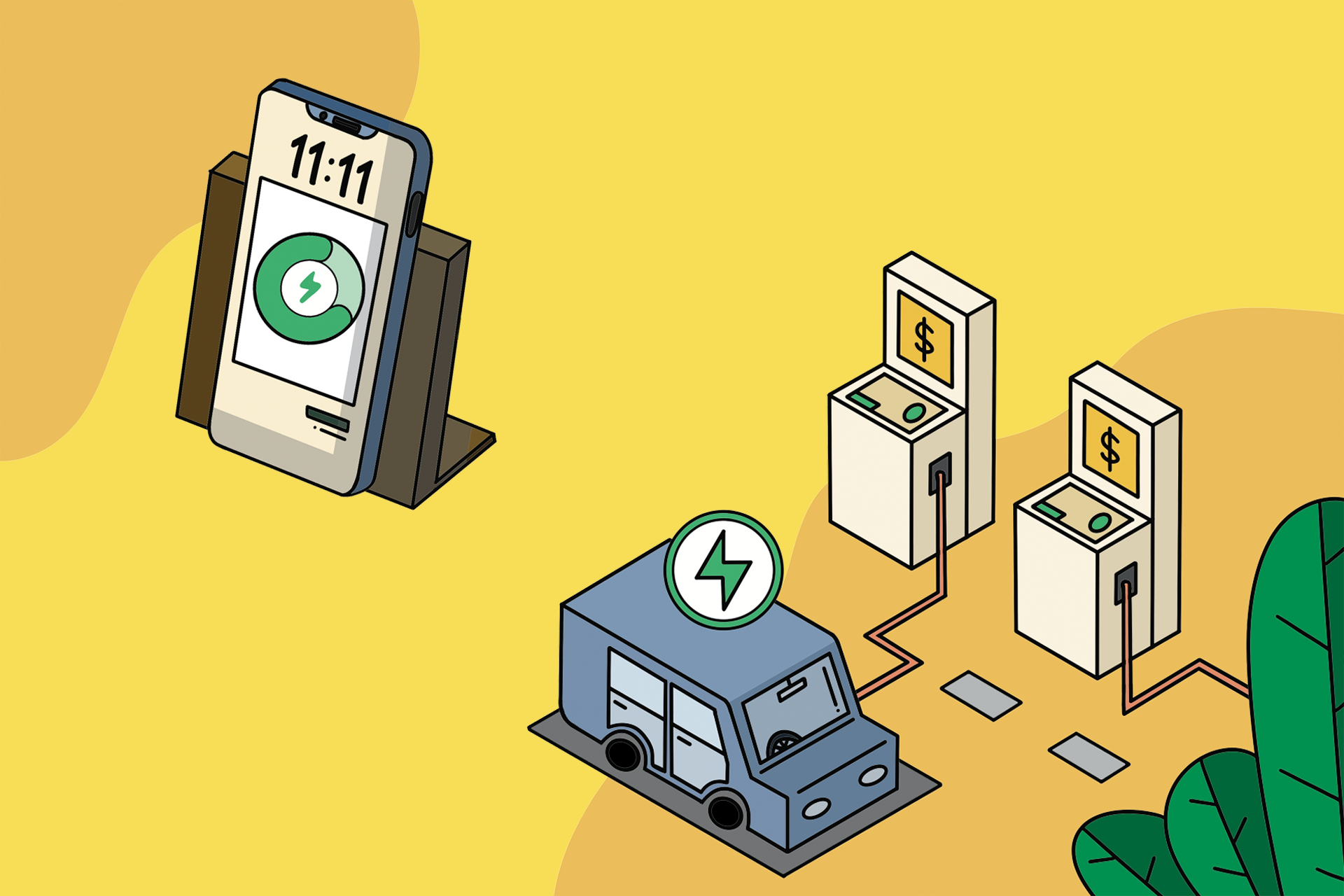
Wireless technology is the new black. Latest technological
advances helped us ditch the hassle of cables and enjoy
seamless use of devices with wireless charging pads and
stands. Have you ever wondered how these chargers work? The
answer is much simpler than you might think!
Wireless charging, also called inductive charging, is based
on some physical principles of electromagnetism and
electromagnetic induction. The first principle to know is
Ampere’s law, which implies that an electric current in a
conductor generates a magnetic field with a strength
proportional to the current. If we pass a current through a
solenoid (a helical coil), the solenoid becomes an
electromagnet with the north and south poles at either of its
ends depending on the current direction.
This is the transmitter coil installed in the charging pad.
When the transmitter is plugged in, a current runs through
the coil and turns it to an electromagnet. An alternating
current (a.c.) with the direction of electron flow reverses
regularly can be supplied, so that we get an electromagnet
with the two poles switching constantly, creating a changing
magnetic field.
Then here comes the second principle: Faraday’s law of
electromagnetic induction. Discovered by Michael Faraday in
1831, this law states that a changing magnetic field can
induce a voltage called an electromotive force (e.m.f.),
which can drive a current to flow through a conductor.
Let’s say we take advantage of this principle and install a
receiver coil into the device we want to charge. The coil
picks up the changing magnetic field and develops an e.m.f.
across it, eventually inducing a current to flow through the
device. Voilà, the current is now transmitted wirelessly. As
smartphones and watches can only be charged by direct current
(d.c.), there is an electrical device called a rectifier to
convert the induced a.c. into d.c. by restricting the
electron flow to only one direction.
Many people may not know: wireless charging could be much
more than a convenient accessory for your phone. Researchers
have long sought a wireless solution to power biomedical
devices. Theoretically, magnetic fields can penetrate the
skin to induce a current to charge the implanted device [1].
This capability could be a game-changer, eliminating the need
of repeated surgeries to replace pacemaker batteries [2], and
the infection risk associated with percutaneous wire
insertion to power left ventricular assist devices
(mechanical pumps for patients with advanced heart failure)
[3]. Nevertheless, before the wireless charging technology
can be commercialised in biomedical devices, some technical
challenges still need to be overcome, such as misalignment
between coils and burn injury caused by the high-power
transmission [2, 4].
Wireless charging systems could be a future direction for
electric cars as well. Mercedez-Benz has already been
offering a wireless charging option in a car model back in
2017 [5]. Recently, the leading electric car company Tesla
has also expressed interest in developing their own wireless
charging technology [6]. However, infrastructural support,
such as setting up charging stations with charging pads, is
crucial to the promotion of the use of wireless charging.
This may explain the general reluctance of car manufacturers
to incorporate wireless technology into their products [6].
It is a chicken and egg situation: the motivation of car
companies to invest in wireless technology is driven by the
demand of electric cars, which, however, is now hindered by
the accessibility to public charging.
Although a lot of development is still due, engineers have
conceived some futuristic ideas in city planning. Detroit has
built the first wireless charging road in the US with
electromagnetic coils installed underground for pilot testing
[7]. While driving down the 400-meter road, the car battery
can be charged through inductive charging. This could be a
solution to extend the range of electric vehicles.
This is just a glance at what wireless charging could do. In
a desire to make technology better and smarter, developers
take on the responsibility to make our lives easier without
wires. From homes to high-tech endeavours, more and more
devices go wireless. What’s next?
References:
-
Mussivand, T., Miller, J. A., Santerre, P. J.,
Belanger, G., Rajagopalan, K. C., Hendry, P. J., Masters,
R. G., Holmes, K. S., Robichaud, R., Keaney, M., Walley,
V. M. & Keon, W. J. (1993). Transcutaneous Energy
Transfer System Performance Evaluation. Artificial
Organs, 17(11), 940–947.
https://doi.org/10.1111/j.1525-1594.1993.tb00407.x -
Salloum, W., Ghosson, Y., & Fardoun, A. (2022).
Wireless Pacemaker Battery Charger. 2022 IEEE 4th Eurasia
Conference on Biomedical Engineering, Healthcare and
Sustainability (ECBIOS).
https://doi.org/10.1109/ECBIOS54627.2022.9944998
-
Pya, Y. (2020). Transcutaneous Energy Transmission:
Can we do it now? The VAD Journal, 6(2), e2020624.
https://doi.org/10.11589/vad/e2020624 -
Horie, H., Isoyama, T., & Ishiyama, K. (2023). Design
of an Innovative Wireless Left Ventricular Assist Device
Driven by either Extracorporeal Magnets or an
Intracorporeal Battery Pack. ASAIO Journal, 69(2),
e73-e79.
https://doi.org/10.1097/MAT.0000000000001874 -
Mercedes-Benz of Silver Spring. (n.d.).
Mercedes-Benz, Qualcomm Unveil Wireless Charging for
Plug-in Hybrid S-Class.
https://news.mercedesbenzsilverspring.net/article/mercedes-benz-qualcomm-unveil-wireless-charging-for-hybrid-s-class -
Alake, T. (2024, February 20). Wireless Charging for
Electric Cars Is Inching Closer to Reality. Bloomberg.
https://www.bloomberg.com/news/articles/2024-02-20/wireless-charging-for-electric-cars-is-inching-closer-to-reality
-
Paris, M. (2022, January 31). Wireless charging: The
roads where electric vehicles never need to plug in. BBC.
https://www.bbc.com/future/article/20240130-wireless-charging-the-roads-where-electric-vehicles-never-need-to-plug-in
Author:
Daria Zaitseva, Student Editor, Science Focus, The Hong Kong
University of Science and Technology
Illustration:
Coby Ngai, Graphic Designer, Science Focus, The Hong Kong
University of Science and Technology
June 2025
Leave a Reply